
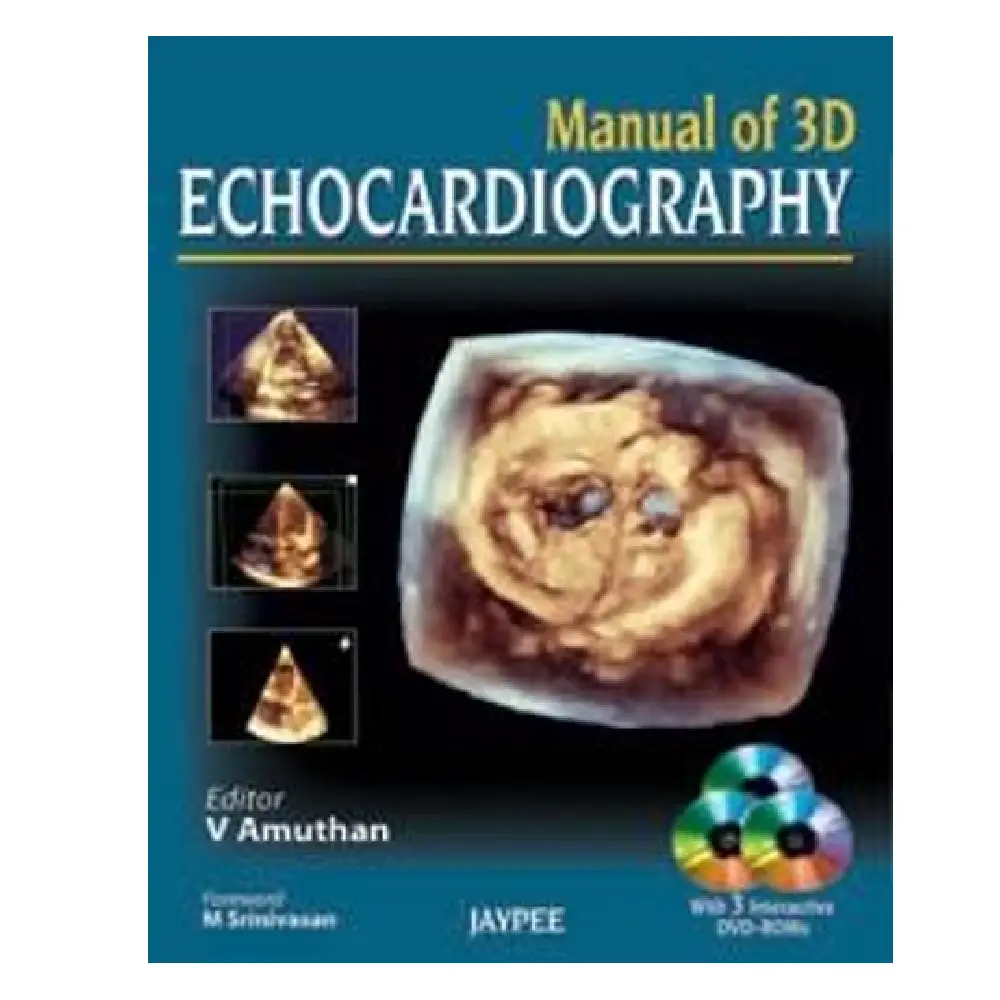


Manual of 3D Echocardiography
Three-dimensional (3D) echocardiography represents a major advancement in cardiac imaging, providing realistic visualization of cardiac structures and more accurate assessment of cardiac anatomy and function compared with conventional two-dimensional (2D) echocardiography. A Manual of 3D Echocardiography serves as a practical guide for cardiologists, echocardiographers, residents, and sonographers to understand the principles, techniques, applications, and clinical value of this evolving imaging modality.
Introduction to 3D Echocardiography
Traditional 2D echocardiography displays planar images that require mental reconstruction of cardiac structures. In contrast, 3D echocardiography acquires volumetric datasets that can be viewed, rotated, and cropped in real time. This allows clinicians to appreciate the true spatial relationships of cardiac chambers, valves, and great vessels. With improvements in transducer technology, processing speed, and image quality, 3D echocardiography has become increasingly integrated into routine clinical practice.
Principles and Technology
3D echocardiography is based on matrix-array transducers containing thousands of piezoelectric elements that acquire pyramidal datasets rather than single planes. Data acquisition methods include:
-
Live 3D imaging: Real-time visualization of cardiac structures
-
3D zoom: Focused acquisition of specific structures such as valves
-
Full-volume acquisition: Stitching together multiple cardiac cycles to create a large volumetric dataset
-
3D color Doppler: Assessment of blood flow and regurgitant jets
Datasets can be displayed as rendered images, multiplanar reconstructions, or sliced views, enabling detailed anatomical analysis.
Acquisition and Image Optimization
A key component of a 3D echocardiography manual is guidance on image acquisition. Proper patient positioning, ECG gating, breath holding, and optimization of gain, depth, and sector width are essential for high-quality images. The manual typically emphasizes starting with good-quality 2D images before transitioning to 3D acquisition, as image quality in 3D depends heavily on the underlying 2D signal.
Cropping techniques are particularly important, allowing the operator to “dissect” the heart virtually and view structures from unique perspectives, such as the surgeon’s view of cardiac valves.
Clinical Applications
1. Valvular Heart Disease
One of the most significant contributions of 3D echocardiography is in valvular assessment. It provides en-face views of valves, enabling precise evaluation of leaflet anatomy, commissures, and subvalvular apparatus.
-
Mitral valve: Accurate assessment of prolapse, flail segments, and suitability for repair
-
Aortic valve: Planimetry of valve area in aortic stenosis
-
Tricuspid and pulmonary valves: Improved visualization compared with 2D imaging
3D echocardiography is especially valuable for pre-procedural planning and post-intervention assessment.
2. Quantification of Cardiac Chambers
3D echocardiography allows accurate measurement of left and right ventricular volumes and ejection fraction without geometric assumptions. This is particularly beneficial in patients with abnormal ventricular shapes, such as those with cardiomyopathies or congenital heart disease.
3. Congenital Heart Disease
Complex congenital anomalies often involve intricate spatial relationships that are difficult to appreciate on 2D imaging. 3D echocardiography enhances understanding of septal defects, valve abnormalities, and postoperative anatomy.
4. Interventional and Structural Heart Procedures
3D echocardiography plays a crucial role in guiding catheter-based interventions, including:
-
Transcatheter aortic valve implantation (TAVI)
-
Mitral valve repair (e.g., MitraClip)
-
Closure of atrial septal defects and left atrial appendage
Real-time 3D transesophageal echocardiography (TEE) is now a standard imaging tool in many structural heart interventions.
Advantages over 2D Echocardiography
Key advantages highlighted in a manual include:
-
True anatomical visualization
-
Improved accuracy of volume and valve measurements
-
Better communication with surgeons and interventional cardiologists
-
Enhanced educational value for trainees
These benefits translate into improved diagnostic confidence and clinical decision-making.
Limitations and Challenges
Despite its advantages, 3D echocardiography has limitations:
-
Lower temporal and spatial resolution compared with 2D imaging in some settings
-
Dependence on good acoustic windows
-
Increased data processing time
-
Requirement for operator expertise and training
A practical manual addresses these challenges and provides tips to overcome common pitfalls.
Learning and Training
A Manual of 3D Echocardiography typically emphasizes a stepwise learning approach—starting with basic acquisition and display techniques, progressing to advanced quantification and procedural guidance. Case examples, annotated images, and comparison with surgical or CT findings enhance learning and reinforce clinical relevance.
Future Directions
The future of 3D echocardiography includes automation, artificial intelligence–based quantification, fusion imaging with fluoroscopy or CT, and wider use in routine clinical workflows. As technology continues to evolve, 3D echocardiography is expected to become an indispensable component of cardiovascular imaging.
Conclusion
A Manual of 3D Echocardiography provides an essential framework for understanding and applying this powerful imaging modality in modern cardiology. By combining fundamental principles with practical guidance and clinical applications, it enables clinicians to fully harness the advantages of 3D echocardiography. As cardiac imaging moves toward greater precision and minimally invasive interventions, mastery of 3D echocardiography is increasingly vital for residents, practitioners, and specialists alike.








Reviews
There are no reviews yet