
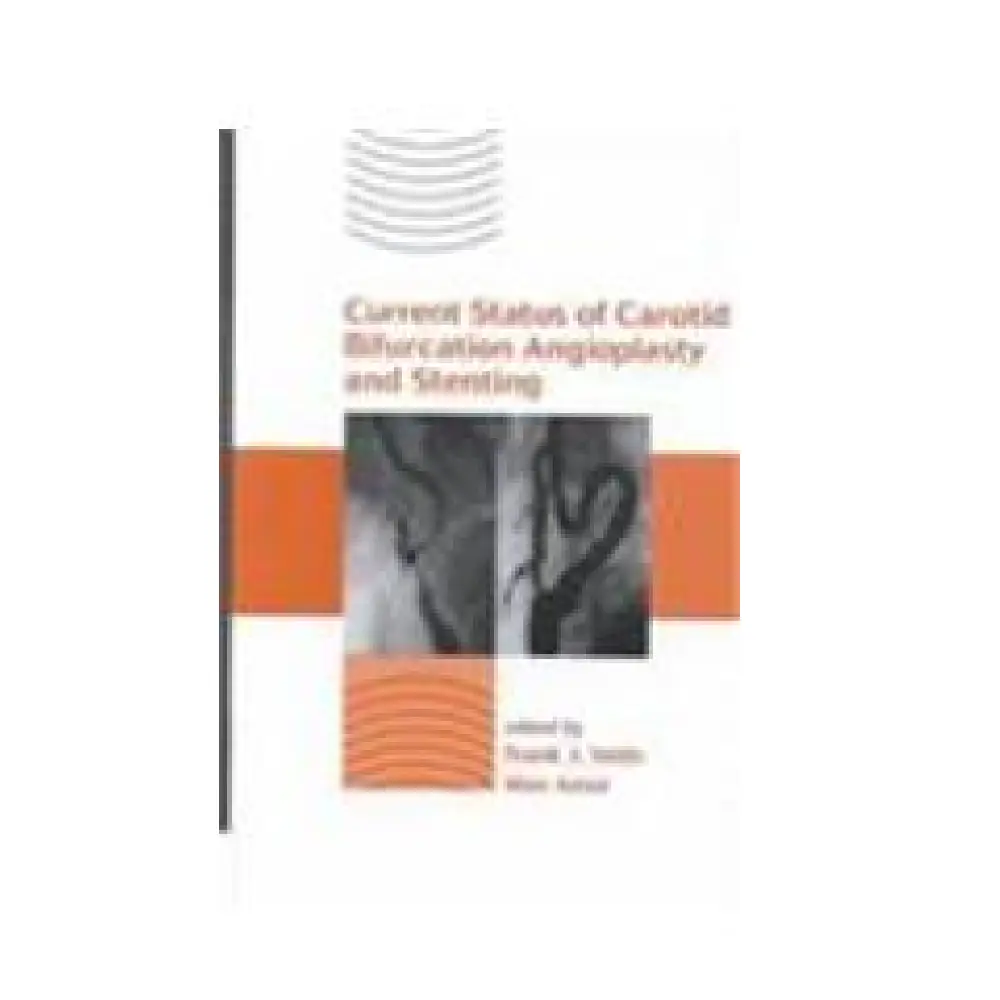


Current Status of Carotid Bifurcation Angioplasty and Stenting
Current Status of Carotid Bifurcation Angioplasty and Stenting, edited by F. J. Veith and M. Amor, is a medical reference that thoroughly examines the evolving role of carotid bifurcation angioplasty and stenting (CBAS) in the treatment of carotid artery disease, particularly stenosis at the carotid bifurcation — the major branching point of the carotid artery in the neck. Published in 2001, the book arises from a consensus of international experts and addresses long‑standing controversies about whether this less invasive intervention can replace or complement traditional carotid endarterectomy (CEA), the gold standard surgical treatment.
Medical Background and Clinical Importance
Carotid artery stenosis — narrowing of a major blood vessel supplying blood to the brain — is a significant risk factor for ischemic stroke, a leading cause of disability and death worldwide. Traditionally, carotid endarterectomy has been the standard intervention for high‑grade symptomatic stenosis, involving open surgery to remove plaque. However, open surgery carries risks of cranial nerve injury, wound complications, and is not suitable for all patients.
In contrast, angioplasty and stenting is a minimally invasive endovascular procedure that uses a balloon to widen the narrowed artery and places a metal stent to keep it open. This approach reduces surgical trauma and may benefit patients who are high‑risk surgical candidates due to comorbid conditions (e.g., heart or lung disease), prior neck surgery, or anatomical challenges.
Consensus and Core Conclusions from the Book
The opening of the book presents results of a consensus conference involving leaders across multiple specialties — vascular surgery, interventional radiology, cardiology, and neurosurgery — who answered and discussed key questions about CBAS to clarify its current therapeutic role. Key consensus points include:
-
CBAS should not be widely adopted in general practice yet — especially not in low‑risk patients — until more robust randomized clinical trials confirm its long‑term safety and effectiveness.
-
It is appropriate for high‑risk patients in experienced centers, especially where surgical risks are high and procedural expertise exists.
-
Neuroprotection measures (devices that reduce the risk of emboli reaching the brain during stenting) should be used when available.
-
There is agreement that adequate stent technology and procedural capability exist, but opinions varied widely on what proportion of patients are ideal candidates.
Overall, consensus was reached on 55 % of major questions, with near‑consensus on 30 %, and only limited disagreement on 15 %, reflecting both progress and ongoing debate in the field.
Comparative Context: Stenting vs. Endarterectomy
Throughout the book and related literature, comparisons with carotid endarterectomy (CEA) remain central. CEA has decades of support from large randomized controlled trials demonstrating durable benefit for symptomatic high‑grade stenosis. Early data on angioplasty and stenting suggested similar short‑term outcomes in selected patients, but its efficacy and long‑term outcomes relative to surgery were not yet conclusively proven at the time of publication.
Subsequent multicenter studies — some referenced in reviews — showed that early angioplasty results without stents had higher neurological complications, but modern cerebral protection devices and stent technology improved safety profiles. Quantitative comparisons like the Carotid and Vertebral Artery Transluminal Angioplasty Study indicated similar stroke and death rates between endovascular and surgical approaches, although restenosis and other factors varied.
Still, most clinical guidelines emerging around that era continued to recommend CEA as the first‑line treatment for most patients, while reserving stenting for those at high risk or with specific indications — for example, recurrent stenosis after surgery or difficult surgical anatomy.
Key Procedural Considerations and Evolving Techniques
The book and associated studies emphasize how technical aspects affect outcomes: meticulous patient selection, operator expertise, use of embolic protection, and stent design all influence procedural success and complication rates. Advanced imaging and monitoring, refined catheter techniques, and procedural training were identified as crucial for minimizing stroke risk.
Advancements since the book’s publication — including new stent designs, better embolic protection systems, and standardized protocols — have continued to refine the practice of carotid stenting and address earlier limitations. These developments point to ongoing evolution rather than static practice.
Controversies and Future Directions
Despite enthusiasm for minimally invasive CBAS, controversy persists regarding its comparative effectiveness, particularly in low‑risk patients and long‑term durability. The book highlights the need for large, well‑controlled randomized trials to validate angioplasty and stenting as routine options. This uncertainty at the time of publication and subsequent studies underscores the need for evidence‑based guidelines rather than anecdotal practice.
Future directions include continued innovation in stent and protection device technology, refinement of patient selection criteria, and integrated clinical trial data to guide optimal use. As data accumulate, practice patterns may increasingly shift, but the fundamental debate documented in Current Status of Carotid Bifurcation Angioplasty and Stenting about balancing minimally invasive benefits with procedural risks remains foundational for clinicians.
Conclusion
Current Status of Carotid Bifurcation Angioplasty and Stenting synthesizes expert opinion, clinical evidence, and procedural insights to present a nuanced view of CBAS as of the early 2000s. It acknowledges both the promise of less invasive intervention and the critical need for rigorous evaluation, making it a valuable resource for clinicians and researchers navigating the complex landscape of carotid artery disease treatment.





Reviews
There are no reviews yet