
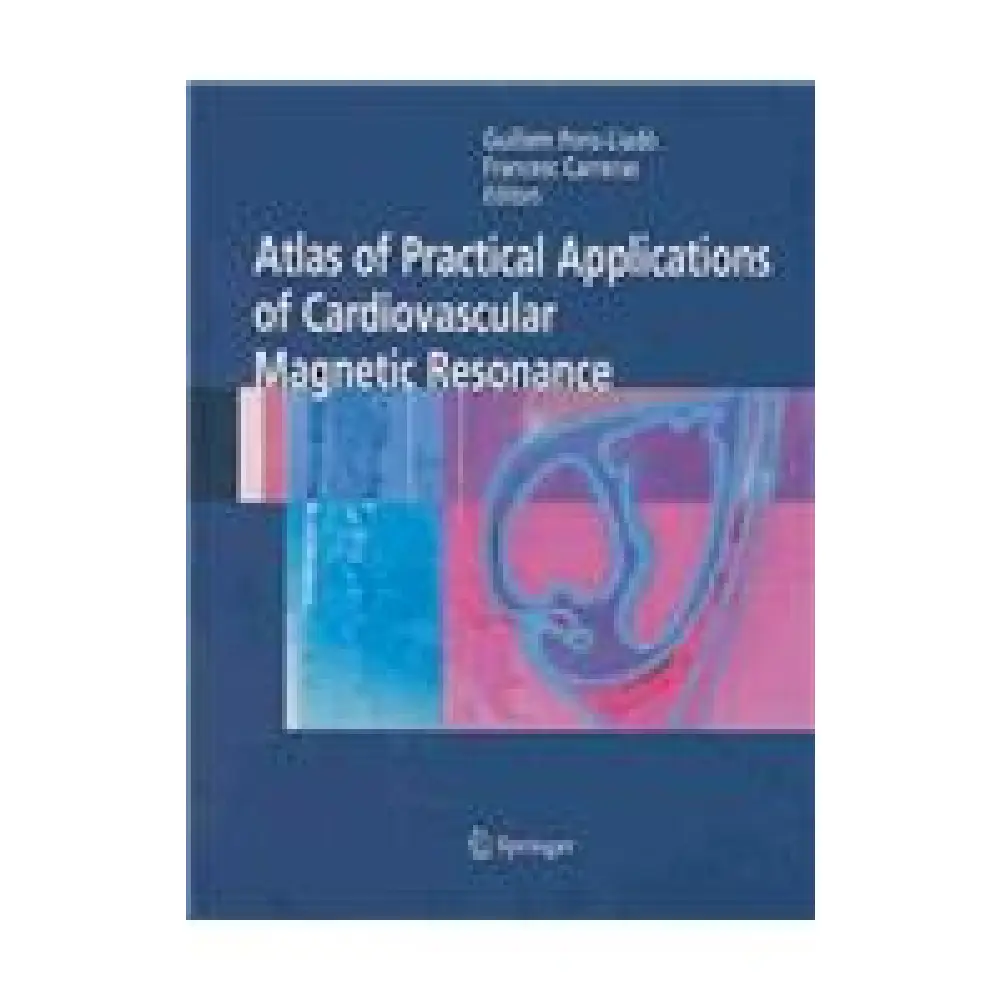


Atlas of Practical Applications of Cardiovascular Magnetic Resonance
Atlas of Practical Applications of Cardiovascular Magnetic Resonance is a clinically oriented imaging reference that focuses on the real-world use of cardiovascular magnetic resonance (CMR) in diagnosing and managing heart and vascular diseases. Designed as a visual and practical guide, the atlas combines high-quality images with concise explanatory text to help clinicians interpret CMR studies accurately and confidently. It serves cardiologists, radiologists, cardiac imaging fellows, technologists, and trainees who are involved in advanced cardiac imaging.
Cardiovascular magnetic resonance has become one of the most powerful non-invasive tools in modern cardiology. Unlike other imaging modalities, CMR provides detailed assessment of cardiac anatomy, ventricular function, myocardial tissue characterization, perfusion, and viability—all without ionizing radiation. This atlas emphasizes the integration of these capabilities into daily clinical practice.
One of the foundational sections of the atlas explains CMR techniques and protocols. It introduces pulse sequences, including steady-state free precession (SSFP) cine imaging for ventricular function, T1- and T2-weighted imaging for tissue characterization, first-pass perfusion imaging for ischemia detection, and late gadolinium enhancement (LGE) for identifying myocardial fibrosis or scar. The technical explanations are presented in a clinically relevant manner, allowing readers to understand not only how images are acquired but also why specific sequences are selected for different clinical questions.
A major portion of the atlas focuses on ischemic heart disease. Through detailed case examples, it demonstrates how CMR identifies myocardial infarction, distinguishes acute from chronic infarcts, and evaluates myocardial viability. LGE imaging is highlighted as a key technique for assessing scar burden and predicting functional recovery after revascularization. Stress perfusion imaging is illustrated with practical examples showing reversible ischemia and microvascular dysfunction.
Cardiomyopathies are another central theme. The atlas presents characteristic imaging findings in dilated cardiomyopathy, hypertrophic cardiomyopathy, restrictive cardiomyopathy, and arrhythmogenic right ventricular cardiomyopathy (ARVC). It emphasizes how tissue characterization with LGE and newer mapping techniques helps differentiate ischemic from non-ischemic cardiomyopathies. The visual format allows readers to recognize classic enhancement patterns associated with various disease processes.
Inflammatory heart diseases, such as myocarditis and pericarditis, are also covered extensively. The atlas demonstrates how T2-weighted imaging and gadolinium enhancement reveal myocardial edema and inflammation. Updated diagnostic criteria for myocarditis are integrated into practical examples, reinforcing how CMR contributes to noninvasive diagnosis.
Congenital heart disease represents another important application. The atlas includes detailed imaging of atrial and ventricular septal defects, complex congenital malformations, and postoperative repairs. Three-dimensional reconstructions and vascular imaging techniques illustrate how CMR provides comprehensive evaluation of anatomy and flow without radiation exposure, making it particularly valuable in younger patients.
Valvular heart disease is addressed through cine imaging and flow quantification techniques. The atlas explains how CMR measures regurgitant volumes, calculates shunt fractions, and evaluates the severity of stenotic lesions. These quantitative capabilities complement echocardiography, particularly in cases where acoustic windows are limited.
The book also covers vascular applications, including imaging of the aorta, pulmonary arteries, and peripheral vessels. Conditions such as aortic aneurysm, dissection, and congenital vascular anomalies are illustrated with high-resolution images. Flow mapping techniques demonstrate how CMR assesses hemodynamics and vascular pathology.
An important strength of the atlas is its case-based format. Each chapter typically presents clinical scenarios, imaging findings, interpretation tips, and key teaching points. This structure enhances learning and bridges theory with practical decision-making. The concise commentary accompanying each image ensures clarity without overwhelming detail.
Safety considerations and practical workflow issues are also discussed. Topics include contraindications to MRI, management of patients with implanted devices, contrast safety, and strategies for optimizing image quality. These practical insights are particularly useful for centers establishing or expanding CMR services.
Overall, Atlas of Practical Applications of Cardiovascular Magnetic Resonance serves as a visually rich and clinically focused guide to modern cardiac imaging. By combining detailed image examples with practical interpretation strategies, the atlas helps clinicians harness the full diagnostic potential of CMR. It stands as an essential resource for those seeking to integrate advanced cardiovascular magnetic resonance into everyday clinical practice.



Reviews
There are no reviews yet