
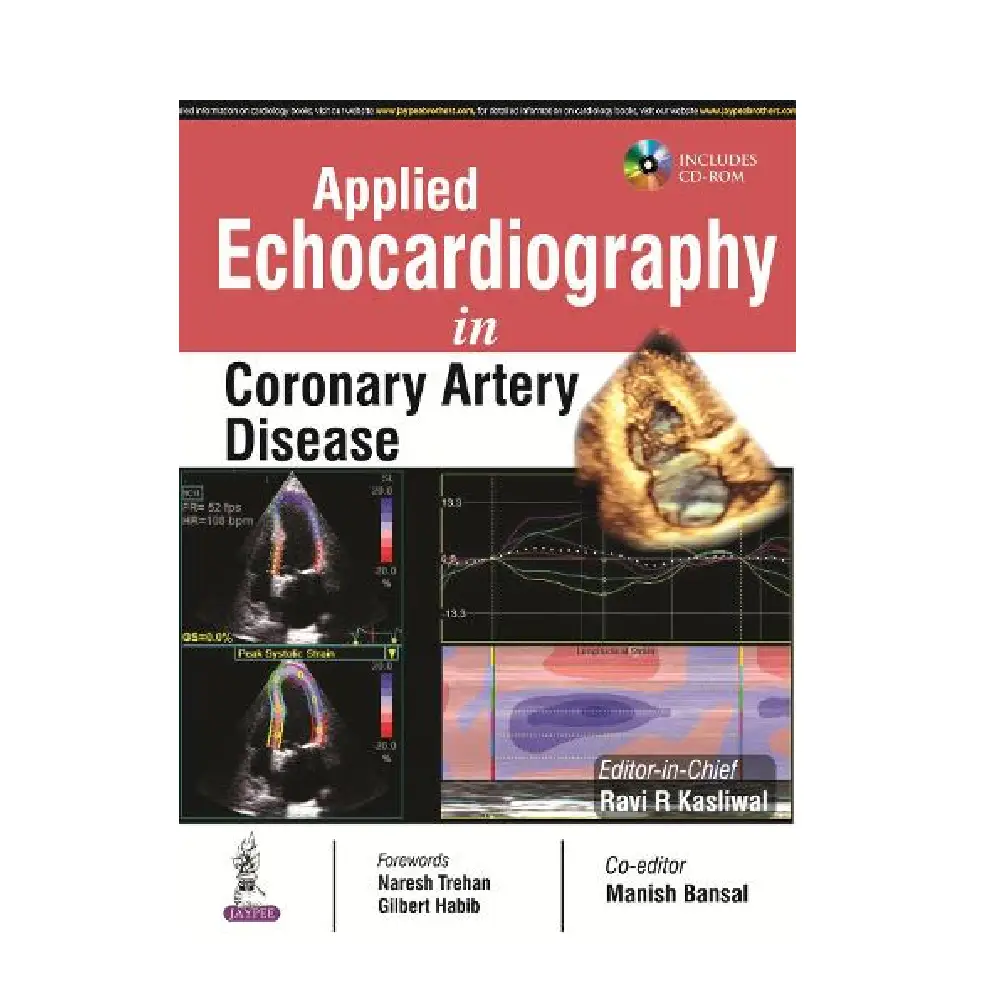
Applied Echocardiography in Coronary Artery Disease
Applied Echocardiography in Coronary Artery Disease is a clinically oriented cardiology text that focuses on the practical use of echocardiography in the diagnosis, risk stratification, and management of coronary artery disease (CAD). Designed for cardiologists, cardiac imaging specialists, anesthesiologists, intensivists, and trainees, the book integrates echocardiographic principles with real-world coronary pathology. Its emphasis is on translating ultrasound findings into meaningful clinical decisions in patients with stable angina, acute coronary syndromes, and post-revascularization states.
Core Focus and Philosophy
The book highlights echocardiography as a first-line, noninvasive, and widely accessible imaging modality in CAD. While coronary angiography remains the gold standard for anatomical visualization of coronary arteries, echocardiography plays a critical complementary role by evaluating myocardial function, wall motion abnormalities, hemodynamic consequences, and mechanical complications.
The central philosophy of the text is that ischemia is fundamentally a disorder of myocardial function before it becomes a structural or electrocardiographic abnormality. Therefore, careful assessment of regional wall motion using transthoracic echocardiography (TTE) or transesophageal echocardiography (TEE) can provide early diagnostic clues.
Fundamental Concepts Covered
The book begins with foundational principles of echocardiography, including ultrasound physics, image acquisition, standard views, Doppler techniques, and quantification of ventricular function. Understanding normal cardiac anatomy and physiology is essential before identifying ischemic patterns.
A major section is devoted to regional wall motion analysis, which remains central to diagnosing CAD. The text explains the 17-segment left ventricular model and correlates each segment with its supplying coronary artery (left anterior descending, left circumflex, and right coronary artery). Hypokinesia, akinesia, and dyskinesia are described in detail, with emphasis on distinguishing acute ischemia from chronic infarction.
Echocardiography in Acute Coronary Syndromes
In patients presenting with chest pain, echocardiography can rapidly assess ventricular function and detect new wall motion abnormalities suggestive of acute myocardial infarction. The book discusses how bedside echocardiography in emergency settings helps differentiate cardiac from non-cardiac causes of chest pain.
Special attention is given to the identification of life-threatening mechanical complications of myocardial infarction, including:
-
Papillary muscle rupture leading to acute mitral regurgitation
-
Ventricular septal rupture
-
Free wall rupture and pericardial tamponade
-
Left ventricular aneurysm formation
Early detection of these complications significantly influences surgical and interventional decisions.
Stress Echocardiography
A comprehensive section addresses stress echocardiography, one of the most valuable tools in the evaluation of stable CAD. Both exercise and pharmacologic stress (e.g., dobutamine) protocols are discussed. The text explains how inducible ischemia manifests as new or worsening regional wall motion abnormalities during stress.
The role of stress echocardiography in risk stratification, preoperative evaluation, and viability assessment is emphasized. Myocardial viability testing helps identify hibernating myocardium that may recover function after revascularization.
Advanced Techniques
Modern echocardiographic techniques are also explored, including:
-
Tissue Doppler imaging
-
Speckle tracking and strain imaging
-
Three-dimensional echocardiography
-
Contrast echocardiography
Strain imaging, in particular, is highlighted for its ability to detect subtle myocardial dysfunction before conventional wall motion abnormalities become evident. Global longitudinal strain (GLS) is presented as a sensitive marker of ischemic injury and prognosis.
Post-Revascularization Assessment
The book discusses the role of echocardiography following percutaneous coronary intervention (PCI) or coronary artery bypass grafting (CABG). It helps evaluate improvement in ventricular function, detect residual ischemia, and monitor complications such as graft failure or recurrent infarction.
Serial echocardiographic evaluation is also useful in long-term follow-up to assess remodeling, heart failure progression, and the development of ischemic cardiomyopathy.
Clinical Integration and Practical Value
Throughout the text, case studies and high-quality echocardiographic images illustrate typical and atypical presentations of CAD. Algorithms guide clinicians through diagnostic pathways based on symptoms, ECG findings, biomarkers, and imaging results.
The book underscores the importance of integrating echocardiographic findings with clinical history and other diagnostic modalities. It avoids overreliance on imaging alone and promotes comprehensive patient evaluation.
Educational Importance
Written in a clear and structured manner, the text is suitable for cardiology fellows, residents, sonographers, and critical care physicians. Its practical orientation makes it valuable for bedside decision-making as well as academic study.
Conclusion
Applied Echocardiography in Coronary Artery Disease serves as an essential resource for understanding how ultrasound imaging enhances the diagnosis and management of coronary pathology. By focusing on myocardial function, ischemic mechanisms, and clinical application, the book reinforces echocardiography’s indispensable role in modern cardiovascular care.



Reviews
There are no reviews yet