
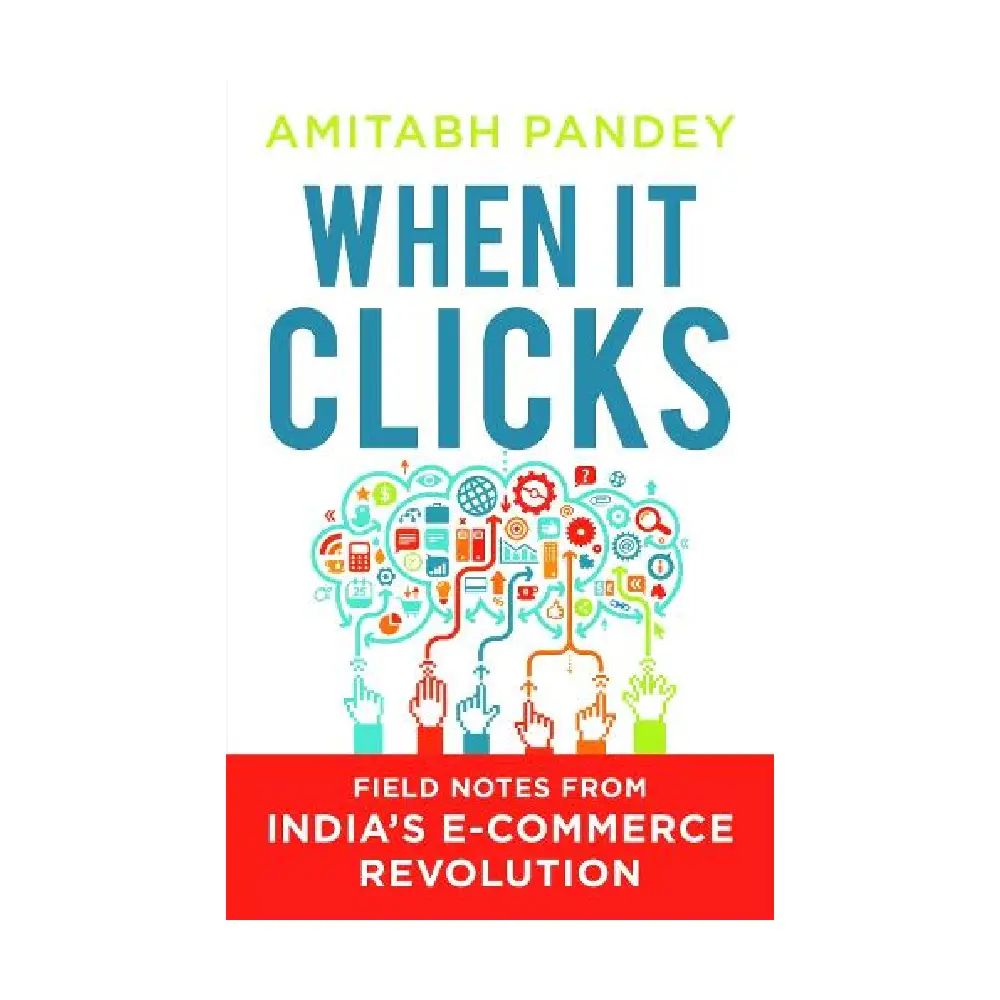


When it Clicks: Field Notes from India’s E-Commerce Revolution is both a chronicle and an analysis of the rapid rise of online commerce in India — one of the world’s fastest-growing and most uniquely challenging digital markets. Written by Francesca Borri and Sramana Mitra, the book takes readers beyond headlines and financial reports to understand how e-commerce reconfigured India’s economy, its entrepreneurs, its consumers, and its social landscape.
The narrative begins with the context of India around the turn of the 21st century: a nation steeped in traditional markets and small retailers, yet poised on the verge of a technological leap. With the proliferation of mobile connectivity, falling data costs, and an expanding middle class, India became fertile ground for digital innovation. But the journey from brick-and-mortar retail to e-commerce was neither smooth nor predictable. The authors frame this transformation as a revolution that clicked — not because it was inevitable, but because a specific convergence of technology, consumer behavior, and entrepreneurial energy made it possible.
A central theme of the book is adaptation to complexity. India’s vast geography, diverse languages, at-times limited infrastructure, and deeply regional consumer habits posed immense challenges for online platforms. Unlike Western markets where e-commerce grew in relatively homogeneous populations with well-established logistics systems, Indian startups had to invent solutions from scratch. Cash-on-delivery was one such innovation — born not from preference but necessity, as millions of Indian consumers were not yet comfortable with digital payments. What may seem like a limitation became a strength, driving unique business models that catered to local realities rather than mimicking Western templates.
The authors blend sharp economic analysis with field reporting. They visit bustling warehouses, interview delivery personnel who traverse rice paddies and narrow alleys, and spend time with young founders who built companies that now challenge global giants. One chapter details journeys with delivery staff in rural areas where doorsteps are unreachable by trucks and packages must be hand-carried kilometers on foot. These “field notes” reveal the human layer often hidden behind algorithms and balance sheets.
Throughout the book, entrepreneurship in India emerges as a study in resilience and ingenuity. Founders describe pivoting strategies, burning through cash to secure market share, and navigating an investor ecosystem that alternated between euphoric funding and harsh skepticism. Marketplace platforms faced fierce competition not only from rivals but from regulators, local shopkeepers, and cultural resistance to online shopping. Yet the promise of scale and inclusion drove venture capital to flow into Indian startups, and firms that survived early battles often did so by innovating aggressively: building logistics networks, mastering data analytics tailored to Indian consumption patterns, and redefining customer service.
The authors devote significant attention to the role of logistics and supply chains. In other economies, delivery networks were already established — a legacy advantage e-commerce players could leverage. In India, the absence of integrated logistics prompted startups to build their own fleets, forge partnerships with local transporters, and experiment with technologies like GPS tracking and warehouse automation. These operational investments consumed time and capital but ultimately enabled faster delivery and broader reach, helping e-commerce penetrate tier-2 and tier-3 cities.
Consumer behavior is another focal point of the book. Indian shoppers exhibited preferences that challenged conventional market research: they valued trust more than convenience, scrutinized product descriptions intensely, and showed strong loyalty when expectations were consistently met. Reviews and ratings systems — pillars of Western e-commerce — had to be tailored to Indian sensibilities where face-to-face reassurance was deeply rooted in buying decisions. The authors highlight how interfaces were localized into regional languages and how user-experience teams designed features based on ethnographic insights rather than imported assumptions.
The book also reflects on government policy and regulation. India’s e-commerce sector did not grow in a vacuum; it was shaped by regulatory debates over foreign direct investment, data localization, and consumer protection. Policymakers often acted with caution to protect small traders from being displaced overnight. While this slowed certain aspects of growth, it also encouraged Indian firms to innovate within regulatory confines rather than rely on foreign investment alone.
A recurring insight in When it Clicks is the idea that technology succeeds only when it serves real human needs. In India, e-commerce was not just about selling goods online — it became a vehicle for financial inclusion, job creation, and a new form of economic participation. Delivery personnel, customer service agents, warehouse workers, and small sellers on digital marketplaces became integral to the ecosystem. Their stories give the book emotional weight: successes and failures are not abstract metrics but lived experiences shaping communities.
The authors conclude with a balanced assessment. India’s e-commerce revolution is neither wholly triumphant nor complete; it is ongoing, shaped by rapid innovation and unpredictable challenges. Yet it offers lessons for emerging markets worldwide: that digital transformation must be rooted in context, built with adaptability, and measured not only in revenue but in social impact.
When it Clicks stands as a compelling resource for business leaders, policymakers, tech entrepreneurs, and anyone interested in how digital markets evolve in complex economies. Its blend of narrative depth and analytical rigor makes it more than a business case study — it is a chronicle of a transformative period in one of the world’s most dynamic markets.








Reviews
There are no reviews yet