
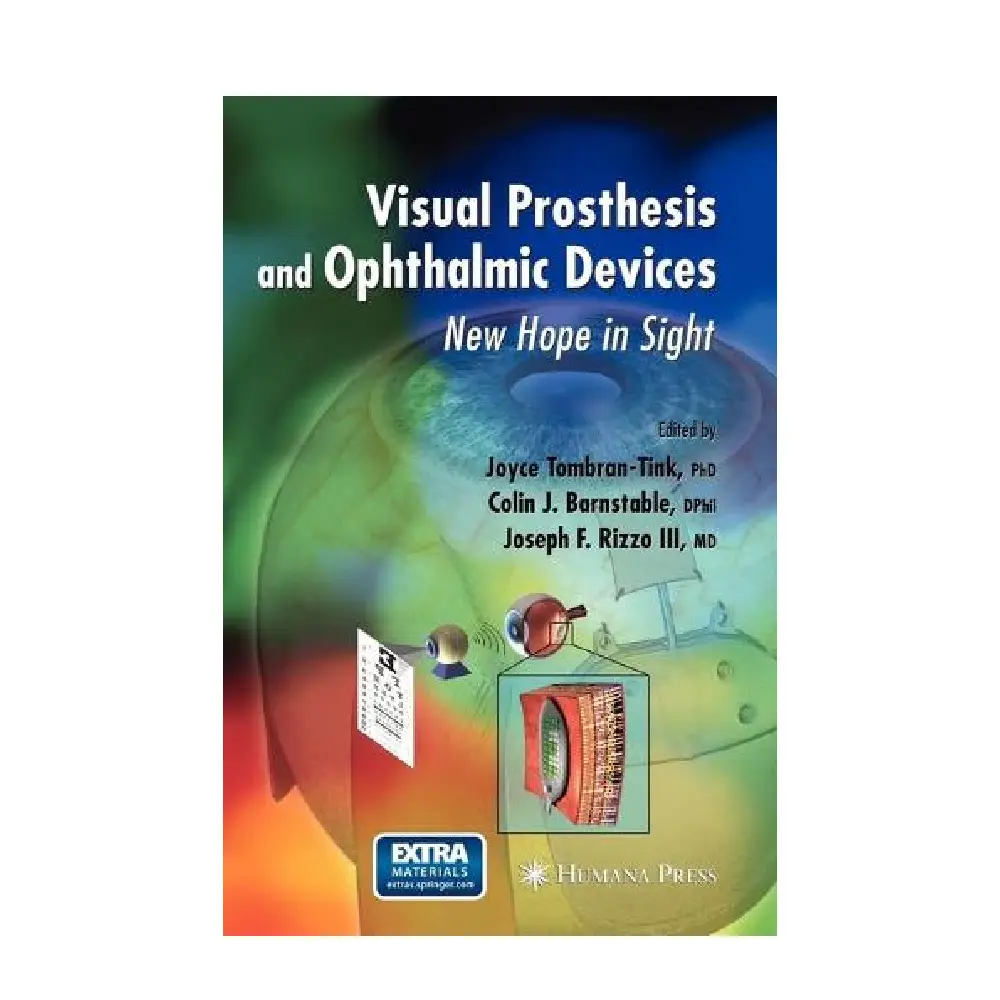

Visual Prosthesis and Ophthalmic Devices: New Hope in Sight is an advanced scholarly resource focused on the development, clinical application, and future of visual prostheses and ophthalmic devices. It provides a comprehensive overview of technologies designed to restore or enhance vision in patients with severe visual impairment or blindness due to retinal, optic nerve, or cortical dysfunction. Bridging engineering, neuroscience, clinical ophthalmology, and rehabilitation science, this text is essential for researchers, clinicians, biomedical engineers, and specialists interested in the frontier of vision restoration.
The Rationale for Visual Prosthesis
Vision loss has profound effects on quality of life, independence, and psychological well-being. While traditional interventions — such as corrective lenses, cataract surgery, or pharmaceutical therapies — address many common ocular conditions, they are ineffective for profound retinal degeneration (e.g., retinitis pigmentosa), optic nerve injury, or advanced macular degeneration. Visual prostheses aim to bypass damaged structures and directly stimulate remaining viable neural circuitry to recreate visual perceptions.
The book begins by contextualizing the need for ophthalmic devices that go beyond conventional treatments. It explains how modern technologies — including microelectronics, biomaterials, neural interfaces, and computer vision algorithms — are converging to provide realistic, functional visual sensations for patients who previously had few options.
Anatomy and Neural Basis of Vision
A foundational section reviews the anatomy and physiology of the visual system. Understanding where and how visual information is processed — from photoreceptors in the retina to the lateral geniculate nucleus (LGN) and visual cortex — is essential for designing effective prosthetic interventions. The text explains:
-
How photoreceptor degeneration affects signal transduction
-
The role of retinal ganglion cells and their connections
-
Neural plasticity and cortical adaptation in response to electrical stimulation
This biological grounding helps explain why certain devices target specific anatomical locations (retina, optic nerve, cortex) depending on the underlying pathology.
Retinal Prosthetic Devices
Retinal prostheses are among the most clinically advanced visual prosthetic technologies. Designed for patients with outer retinal degeneration (e.g., retinitis pigmentosa), these systems bypass damaged photoreceptors and directly stimulate inner retinal neurons.
Key components of retinal prostheses include:
-
External camera and processing unit: Captures visual information and encodes it into electrical signals
-
Transmitter/receiver systems: Transfer signals across the ocular surface
-
Microelectrode array: Implanted on or near the retina to stimulate ganglion cells
The book discusses leading retinal implants — such as epiretinal, subretinal, and suprachoroidal approaches — detailing device architecture, surgical implantation techniques, and clinical outcome metrics. Patient results from early clinical trials are examined, highlighting improvements in light perception, object recognition, and mobility performance.
Optic Nerve and Cortical Prostheses
In cases where the retina or optic nerve is severely damaged, directly stimulating the visual pathways further upstream becomes necessary. The text addresses devices targeting:
-
Optic nerve interfaces: Utilizing cuff electrodes or penetrating arrays to stimulate optic nerve fibers
-
Cortical implants: Placed in the primary visual cortex (V1), aimed at generating visual percepts even when peripheral pathways are non-functional
Each approach carries unique technical and clinical challenges, such as achieving spatial resolution, minimizing tissue damage, and adapting stimulation protocols to individual anatomy. Ethical considerations and patient selection criteria are also discussed in depth.
Advances in Ophthalmic Biomaterials and Microfabrication
The success of visual prosthetic devices depends heavily on advanced materials and microfabrication techniques. The book details:
-
Biocompatible electrode materials (e.g., platinum, iridium oxide)
-
Flexible polymer substrates that conform to ocular tissues
-
Surface coatings that reduce inflammation and scar formation
-
Wireless power and telemetry systems
Engineering challenges — such as maintaining long-term stability in the harsh biological environment of the eye — are paired with emerging solutions from materials science and nanotechnology.
Signal Processing and Image Encoding
A critical aspect of prosthetic vision is not just delivering electrical pulses, but doing so in a way that the brain can interpret meaningfully. This section covers:
-
Image processing algorithms: Converting camera input into stimulation patterns
-
Neural coding strategies: Mimicking natural retinal signaling to improve perception
-
Machine learning applications: Enhancing pattern recognition and adaptation over time
The text highlights how signal processing techniques can dramatically improve functional outcomes by tailoring stimulation to neural response properties.
Clinical Trials and Outcomes
Clinical translation is the ultimate test of any prosthetic technology. The book reviews major clinical trials of retinal prostheses, detailing inclusion criteria, surgical methods, rehabilitation protocols, and performance measures. Insights include:
-
Visual acuity scores before and after implantation
-
Functional tasks such as mobility, object localization, and reading large letters
-
Patient satisfaction and psychosocial adaptation
Limitations are critically assessed, and realistic expectations for current technology are presented alongside strategies for improvement.
Rehabilitation and User Training
Successful use of visual prosthetic devices requires structured rehabilitation. This section discusses:
-
Training patients to interpret phosphenes (patterns of light perceived through electrical stimulation)
-
Mobility and orientation exercises
-
Integration with assistive technologies such as augmented reality and sensory substitution tools
Rehabilitation is framed as a collaborative process involving low vision specialists, occupational therapists, and the patient’s support system.
Ethical, Regulatory, and Accessibility Considerations
Deploying prosthetic vision technologies raises important ethical questions, including:
-
Informed consent in emerging technologies with variable outcomes
-
Device access and cost barriers
-
Long-term follow-up and care responsibilities
The book addresses regulatory pathways (e.g., FDA and CE Mark approvals), reimbursement challenges, and frameworks for equitable access.
Future Directions
Looking forward, the text explores:
-
Integration of optogenetics and gene therapy with prosthetic devices
-
Closed-loop systems that adapt stimulation in real time
-
Nanotechnology for ultra-high-resolution interfaces
-
Cortical plasticity harnessed through neurofeedback
These innovations suggest a future where prosthetic systems might restore not only basic light perception but more nuanced visual experiences.
Conclusion
Visual Prosthesis and Ophthalmic Devices: New Hope in Sight is an indispensable reference for anyone engaged in advancing vision restoration technologies. By combining rigorous scientific foundations with clinical insights and engineering innovation, it offers a visionary yet practical roadmap for transforming the lives of those affected by profound vision loss. Whether as a research text or clinical reference, it bridges the gap between theory and application in the rapidly evolving field of visual prosthetics and ophthalmic devices.








Reviews
There are no reviews yet