
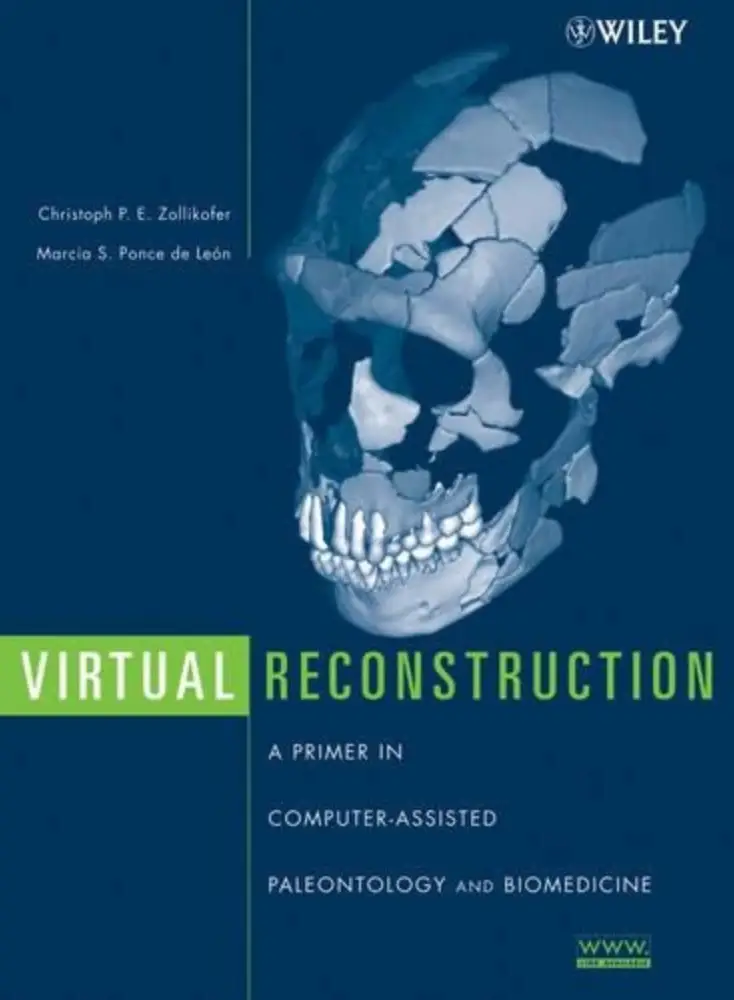
Virtual Reconstruction: A Primer in Computer-Assisted Paleontology and Biomedicine
Virtual Reconstruction: A Primer in Computer-Assisted Paleontology and Biomedicine is an interdisciplinary resource that introduces the principles, techniques, and applications of digital reconstruction in both paleontology and biomedical sciences. The book highlights how modern computational tools have transformed the study of biological structures, enabling researchers to reconstruct, visualize, and analyze complex forms that are otherwise incomplete, damaged, or inaccessible.
The central concept of the book is virtual reconstruction, a process that uses digital imaging and computer-based modeling to recreate physical structures in a virtual environment. This approach is particularly valuable in paleontology, where fossils are often fragmented or distorted due to geological processes. By using advanced imaging techniques such as computed tomography (CT) scanning, researchers can capture detailed internal and external features of fossils without damaging them. The resulting digital datasets can then be manipulated to reconstruct missing parts, correct deformations, and study anatomical features in three dimensions.
In the field of Paleontology, virtual reconstruction has revolutionized the way scientists interpret fossil evidence. It allows for the reconstruction of extinct organisms with greater accuracy and provides insights into their functional morphology, evolutionary relationships, and ecological roles. For example, researchers can simulate jaw movements, analyze bone structures, and estimate muscle attachments, leading to a deeper understanding of how ancient species lived and evolved.
The book also explores applications in Biomedicine, where virtual reconstruction plays a crucial role in medical research and clinical practice. In medicine, digital models of organs and tissues are used for surgical planning, prosthesis design, and education. Techniques such as 3D imaging and modeling enable clinicians to visualize complex anatomical structures, improving diagnostic accuracy and treatment outcomes. For instance, virtual reconstruction of the skull or vascular system can assist surgeons in planning intricate procedures with reduced risk.
A significant portion of the book is dedicated to the technical aspects of virtual reconstruction. It explains the workflow involved, starting from data acquisition through imaging technologies like CT and MRI, followed by image processing, segmentation, and 3D modeling. Segmentation, the process of isolating specific structures from imaging data, is particularly emphasized as a critical step that requires both technical skill and anatomical knowledge. The authors provide guidance on selecting appropriate software tools and methodologies for different types of reconstruction tasks.
The book also addresses challenges and limitations associated with virtual reconstruction. These include issues such as data quality, resolution constraints, and the potential for user bias during reconstruction. The authors stress the importance of transparency and reproducibility in digital research, encouraging the use of standardized protocols and documentation to ensure that results can be validated and shared within the scientific community.
Another important theme is the integration of virtual reconstruction with quantitative analysis. Digital models can be used to perform biomechanical simulations, statistical shape analysis, and other computational studies. These approaches enable researchers to test hypotheses about function and evolution in ways that were not possible with traditional methods. The ability to share digital models across institutions also fosters collaboration and accelerates scientific discovery.
Educational applications are also highlighted. Virtual reconstruction provides powerful tools for teaching anatomy, paleontology, and related disciplines. Students can interact with 3D models, explore structures from different angles, and gain a deeper understanding of spatial relationships. This interactive approach enhances learning and makes complex concepts more accessible.
In conclusion, Virtual Reconstruction: A Primer in Computer-Assisted Paleontology and Biomedicine offers a comprehensive introduction to a rapidly evolving field that bridges technology and biological sciences. By combining theoretical foundations with practical guidance, the book demonstrates how digital reconstruction techniques are transforming research, education, and clinical practice. It serves as an essential resource for students, researchers, and professionals interested in leveraging computational tools to explore the structure and function of biological systems, both past and present.



Reviews
There are no reviews yet