
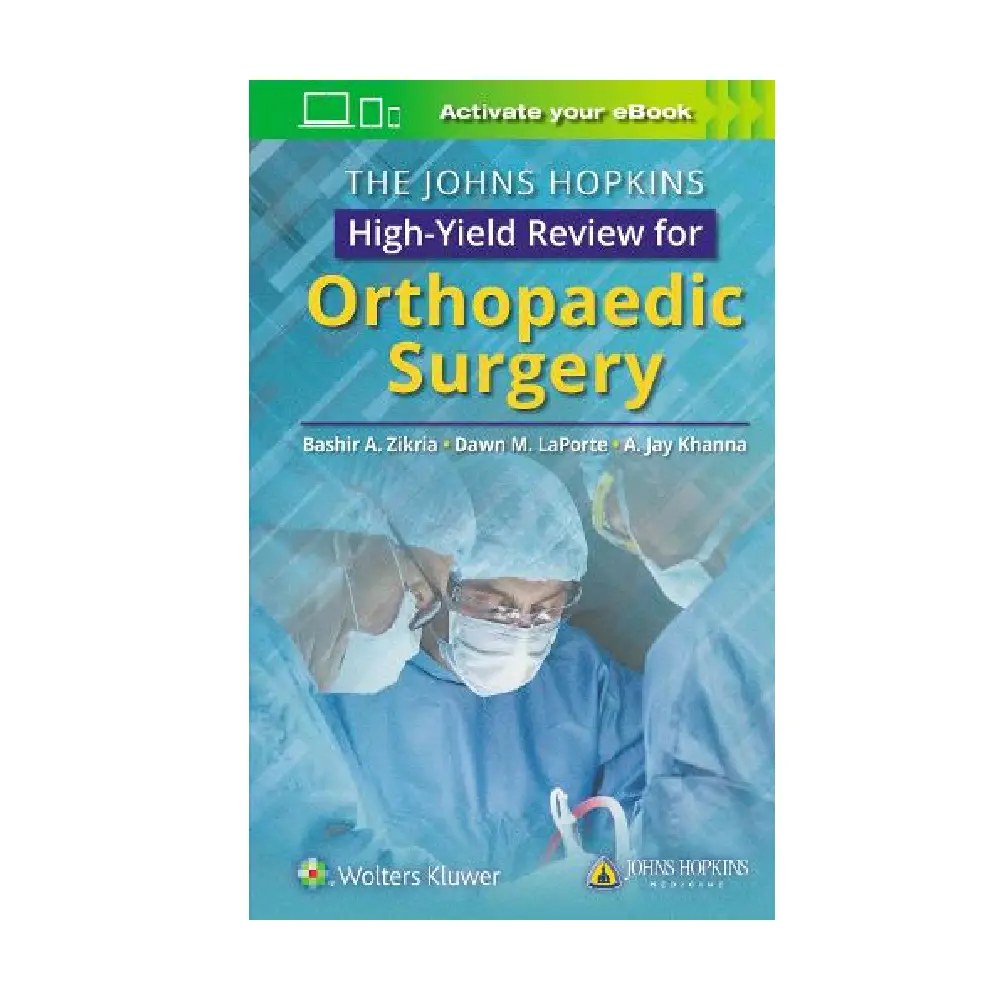
The Johns Hopkins High-Yield Review for Orthopaedic Surgery
The Johns Hopkins High-Yield Review for Orthopaedic Surgery is a concise, exam-focused review designed to help residents, fellows, and practicing surgeons consolidate essential knowledge in orthopaedics. Developed by experts affiliated with Johns Hopkins University, the book reflects a strong academic foundation combined with practical clinical insight. It is particularly valuable for candidates preparing for orthopaedic in-training examinations (OITE), board certification, recertification, and fellowship entrance exams.
Purpose and Target Audience
This high-yield review is tailored primarily for orthopaedic residents who need a rapid yet comprehensive revision resource. The structure emphasizes core concepts, frequently tested topics, and clinically relevant facts. It is also useful for medical students considering orthopaedics and fellows seeking a structured refresher before specialty examinations.
The book’s hallmark is its focused, bullet-point style presentation. Rather than lengthy theoretical discussions, it prioritizes essential definitions, mechanisms of injury, classification systems, diagnostic criteria, and management algorithms.
Organization and Structure
The content is systematically divided into major orthopaedic subspecialties, including:
-
Trauma
-
Sports medicine
-
Adult reconstruction
-
Spine surgery
-
Pediatric orthopaedics
-
Hand and upper extremity
-
Foot and ankle
-
Musculoskeletal oncology
-
Basic science
Each section is designed for rapid review, often including summary tables, flowcharts, and classification outlines. These features allow readers to quickly recall key points under exam pressure.
Trauma and Fracture Management
The trauma section provides an efficient overview of fracture principles, including biomechanics, fracture healing, and fixation techniques. It reviews common fractures by anatomical region—such as clavicle, proximal humerus, distal radius, hip, femur, tibia, and ankle—along with indications for operative versus non-operative management.
Key classification systems (e.g., AO classification, Garden classification for femoral neck fractures, Schatzker classification for tibial plateau fractures) are summarized clearly, as they frequently appear in examinations.
Sports Medicine
The sports medicine section covers ligamentous injuries, meniscal pathology, rotator cuff tears, shoulder instability, and cartilage injuries. Emphasis is placed on clinical tests, imaging findings, surgical indications, and postoperative rehabilitation principles.
Common board questions relating to anterior cruciate ligament (ACL) injuries, meniscus repair versus meniscectomy, and shoulder labral tears are addressed in a concise, practical format.
Spine Surgery
The spine section outlines degenerative, traumatic, infectious, and neoplastic conditions of the cervical, thoracic, and lumbar spine. It summarizes neurological examination findings, radiographic interpretation, and surgical indications. Conditions such as lumbar disc herniation, spondylolisthesis, spinal stenosis, and cervical myelopathy are discussed with clear management pathways.
Pediatric Orthopaedics
This portion focuses on developmental dysplasia of the hip (DDH), slipped capital femoral epiphysis (SCFE), Legg–Calvé–Perthes disease, clubfoot, and growth plate injuries. Growth-related biomechanics and pediatric fracture patterns are emphasized, helping readers distinguish pediatric-specific considerations from adult orthopaedic care.
Musculoskeletal Oncology and Infection
The oncology section reviews benign and malignant bone tumors, including osteosarcoma, Ewing sarcoma, and chondrosarcoma. Classic radiographic features and age associations are presented in a memory-friendly format.
Infection topics include osteomyelitis, septic arthritis, and prosthetic joint infection, with key laboratory markers and management algorithms outlined succinctly.
Basic Science Foundation
A significant strength of the book lies in its coverage of orthopaedic basic science. Topics such as bone biology, cartilage physiology, biomechanics, biomaterials, and implant design are summarized clearly. These foundational concepts are critical for in-training and board examinations.
Educational Value
The question-oriented style of the text mirrors exam expectations. Many sections integrate clinical pearls and “must-know” facts, improving retention. The format supports short, focused study sessions, making it ideal for busy residents balancing clinical duties.
Because the book is concise, it is best used as a companion to larger orthopaedic reference texts rather than a standalone learning resource. It excels in rapid revision and exam preparation but does not aim to provide exhaustive operative technique details.
Conclusion
The Johns Hopkins High-Yield Review for Orthopaedic Surgery is a practical, structured, and exam-focused resource that distills complex orthopaedic knowledge into accessible, high-yield content. Its organized layout, emphasis on classification systems, and clinically relevant summaries make it an indispensable review tool for orthopaedic trainees preparing for competitive examinations and board certification.





Reviews
There are no reviews yet