
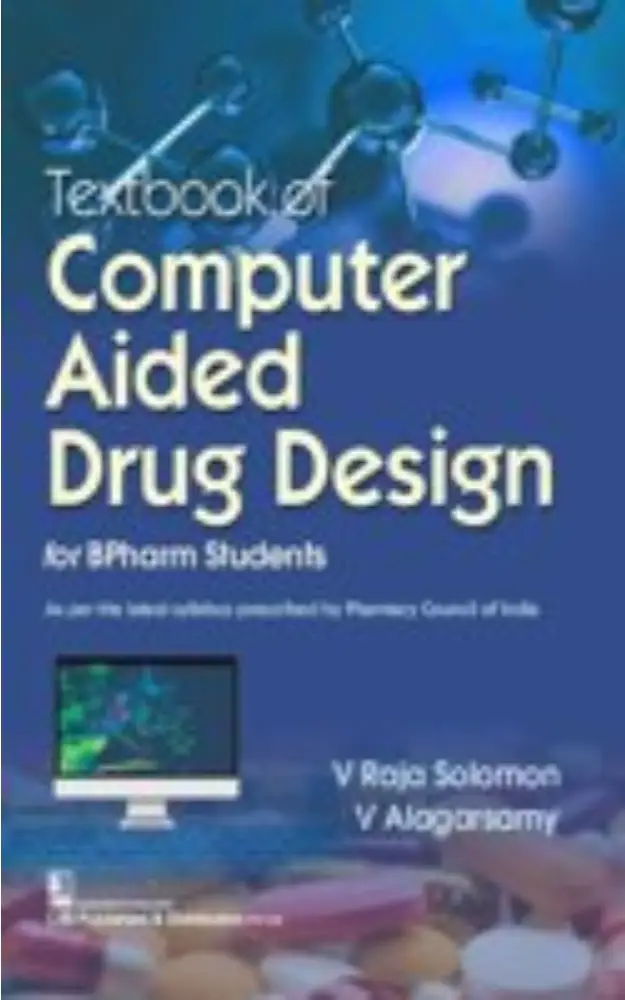
Textbook of Computer Aided Drug Design for BPharma Students
Textbook of Computer Aided Drug Design for BPharma Students is a foundational resource that introduces pharmacy students to the principles and applications of computational techniques in modern drug discovery and development. The book is specifically tailored to meet the academic needs of Bachelor of Pharmacy (BPharm) students, presenting complex concepts in a simplified and structured manner. It bridges the gap between theoretical pharmaceutical sciences and practical computational approaches, making it highly relevant in today’s data-driven drug development landscape.
The book begins with an overview of drug discovery, outlining traditional methods and highlighting the limitations that led to the development of computer-aided drug design (CADD). It explains how computational tools have revolutionized the pharmaceutical industry by reducing time, cost, and failure rates in drug development. The introduction sets the stage for understanding the importance of integrating chemistry, biology, and computer science in designing effective therapeutic agents.
A significant portion of the text is dedicated to the fundamentals of molecular modeling. Students are introduced to the structure of biological targets such as proteins, enzymes, and receptors, and how these structures can be visualized and analyzed using computer software. Concepts such as molecular geometry, energy minimization, and conformational analysis are explained in a clear and accessible way, providing a strong foundation for further learning.
The book thoroughly covers two major approaches in CADD: structure-based drug design and ligand-based drug design. Structure-based drug design focuses on the three-dimensional structure of the target molecule, often obtained through techniques like X-ray crystallography or NMR spectroscopy. The text explains how this structural information is used to design molecules that can bind effectively to the target site. Key techniques such as molecular docking and virtual screening are discussed, with emphasis on their role in identifying potential drug candidates.
Ligand-based drug design, on the other hand, is introduced as an approach used when the structure of the target is not known. The book explains how information from known active compounds can be used to develop new drugs. Concepts such as pharmacophore modeling, quantitative structure–activity relationship (QSAR), and similarity searching are presented in a student-friendly manner. These methods help in predicting the biological activity of new compounds based on their chemical structure.
Another important aspect covered in the book is the role of databases and bioinformatics tools in drug design. It introduces commonly used chemical and biological databases, which store vast amounts of information about compounds, targets, and biological activities. The text explains how these resources can be used for data mining and analysis, enabling researchers to make informed decisions during the drug design process.
The book also discusses molecular dynamics simulations, which allow researchers to study the behavior of molecules over time. This technique provides insights into the stability and interactions of drug-target complexes, helping to refine and optimize drug candidates. Additionally, the text touches upon the concept of ADMET (Absorption, Distribution, Metabolism, Excretion, and Toxicity) prediction, which is crucial for evaluating the safety and efficacy of potential drugs early in the development process.
Practical applications and case studies are included to help students understand how theoretical concepts are applied in real-world scenarios. These examples demonstrate the successful use of CADD in developing drugs for various diseases, reinforcing the relevance of computational methods in modern pharmacy.
The book is designed with clear explanations, diagrams, and step-by-step approaches that make it easy to follow. It serves as both a textbook for academic study and a reference for understanding the basics of computational drug design.
In conclusion, Textbook of Computer Aided Drug Design for BPharma Students provides a comprehensive introduction to the principles and tools of CADD. Its student-focused approach, combined with practical insights, makes it an essential resource for aspiring pharmacists. By equipping learners with computational skills, the book prepares them to contribute effectively to the evolving field of drug discovery and pharmaceutical research.


Reviews
There are no reviews yet