

Introduction
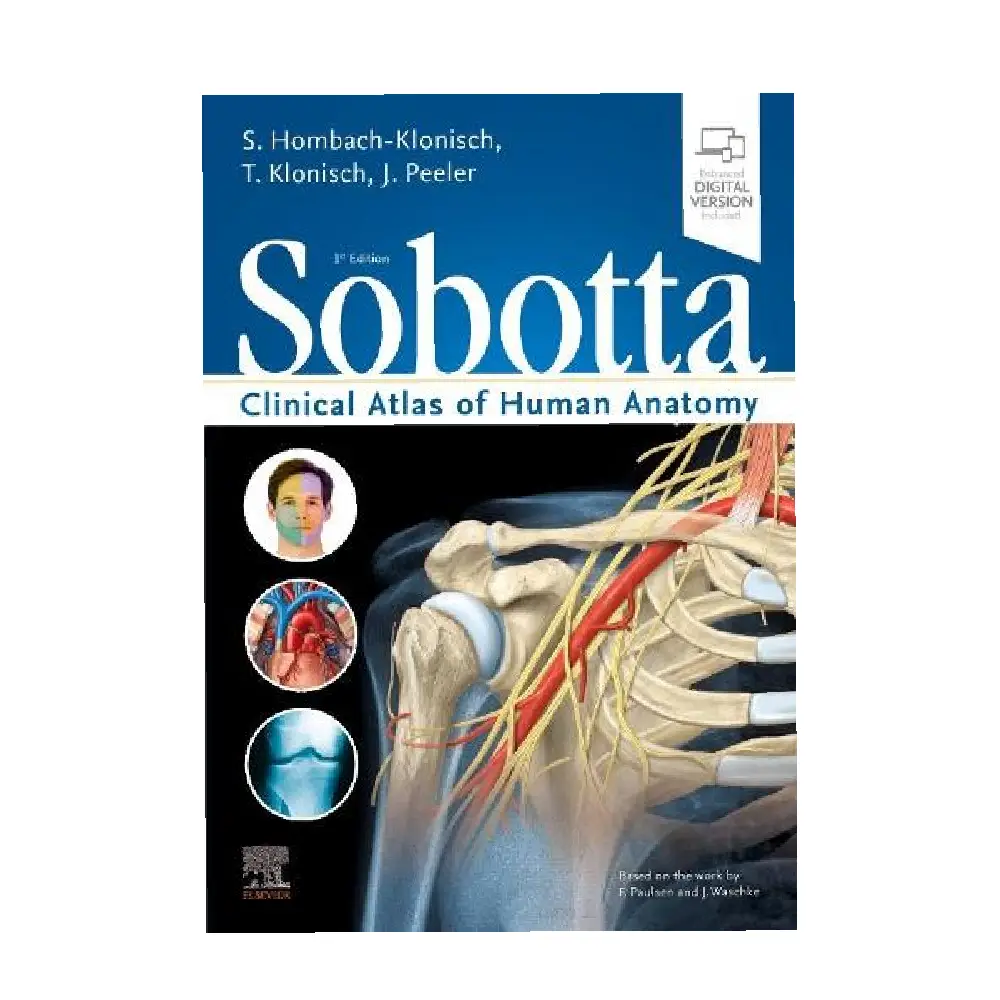
The Sobotta Clinical Atlas of Human Anatomy, one volume, English is a modern, clinically oriented anatomical atlas designed primarily for medical and health professional students. First published in this one-volume English edition in 2019 by Elsevier Health Sciences, the atlas integrates high-quality illustrations with clinical context to support not just memorization of structures, but understanding of anatomy in relation to real-world patient care and diagnostic imaging.
Unlike traditional discipline-only atlases that focus solely on pictorial depictions of anatomy, the Sobotta Clinical Atlas emphasizes a regional approach—mirroring how students learn anatomy in coursework and how clinicians apply anatomical knowledge in practice. The atlas is tailored to connect anatomical structure with function and clinical relevance, making it a valuable resource throughout preclinical coursework and into clinical training.
Authorship and Edition
-
Author(s): Jens Waschke and Friedrich Paulsen (primary authors/editors)
-
Editors: Sabine Hombach-Klonisch, Thomas Klonisch, Jason Peeler
-
Edition: 1st Edition (2019)
-
Publisher: Elsevier Health Sciences
-
Language: English
-
Format: One volume (print)
-
ISBN-13: 978-0702052736
-
Publication Year: 2019
Purpose and Target Audience
The Sobotta Clinical Atlas is explicitly aimed at:
-
Medical students
-
Dental students
-
Nursing and allied health professionals
-
Students in physiotherapy, pharmacy, physician assistant, and kinesiology programs
Its goal is to deliver an integrated visual and textual resource that makes anatomy easier to learn, remember, and apply—especially where clinical decision-making and diagnostic interpretation are required.
Content and Organization
The atlas follows a regional structure of the human body, meaning it breaks down anatomy by body areas rather than by separate systems. This approach aligns well with how anatomy is taught in most medical curricula and how clinicians refer to anatomy in practice.
Key sections typically include:
-
General Anatomy – Introduction to anatomical terms, orientation, and foundational concepts.
-
Back and Spine – Structural anatomy and relevant clinical correlations.
-
Upper Extremity – Bones, muscles, nerves, and vascular anatomy of the upper limb.
-
Lower Extremity – Detailed regional anatomy of the lower limb.
-
Thorax – Structures of the chest, heart, lungs, and associated spaces.
-
Abdomen – Abdominal viscera and supporting anatomical structures.
-
Pelvis – Pelvic organs, musculature, and neurovascular anatomy.
-
Head, Eye, Ear, Neck – Cranial anatomy and sensory organ regions.
-
Neuroanatomy – Brain, spinal cord, and major neural pathways.
This progression enables learners to link basic anatomical knowledge with clinical application, and to transition from foundational learning to more complex regional and systemic contexts.
Illustrations and Visual Features
A key strength of this atlas is its extensive visual content:
-
More than 1,850 high-quality images including classic anatomical figures.
-
Radiological and cross-sectional illustrations that help bridge textbook anatomy with imaging interpretation used in clinical settings.
-
Surface anatomy visuals that prepare students for physical examination skills.
-
Functional anatomy diagrams that show how structures operate and relate in movement and physiology.
Each image is labeled clearly and accompanied by descriptive text that reinforces key features and clinical significance, making it far more than a static picture book. Summary tables help organize concepts and aid rapid review.
Clinical Integration and Learning Aids
What sets the Sobotta Clinical Atlas apart from more traditional atlases are its clinical notices:
-
“Clinical Remarks” highlight relevance to pathology and common medical practice.
-
“Structure/Function” vignettes tie anatomical detail to physiological roles.
-
Regional approach helps learners place structures into practical context rather than isolated memorization.
Additionally, the atlas often includes access codes to complementary digital content, offering online or e-book access for study on various devices.
Strengths
-
Comprehensive and clinically relevant: integrates anatomy with clinical reasoning.
-
Strong visual presentation: extensive, clearly labeled illustrations support deep learning.
-
Useful across curricula: from gross anatomy labs to clinical courses.
-
Concise one-volume format: makes it easier to manage than multi-volume atlases.
Limitations
-
Its depth and range of imagery may be more than beginners need initially; horizontal integration with textbooks is recommended.
-
One volume can still be a large and dense resource, which might feel heavy for quick reference without structured guidance.
Conclusion
The Sobotta Clinical Atlas of Human Anatomy, one volume, English is a modern, learner-centric, and clinically integrated anatomy atlas. It combines the traditional strength of detailed anatomical illustrations with clinical insights, imaging correlations, and practical educational design. This makes it an invaluable tool for students poised to bridge basic anatomy with patient care and medical practice.




Reviews
There are no reviews yet