
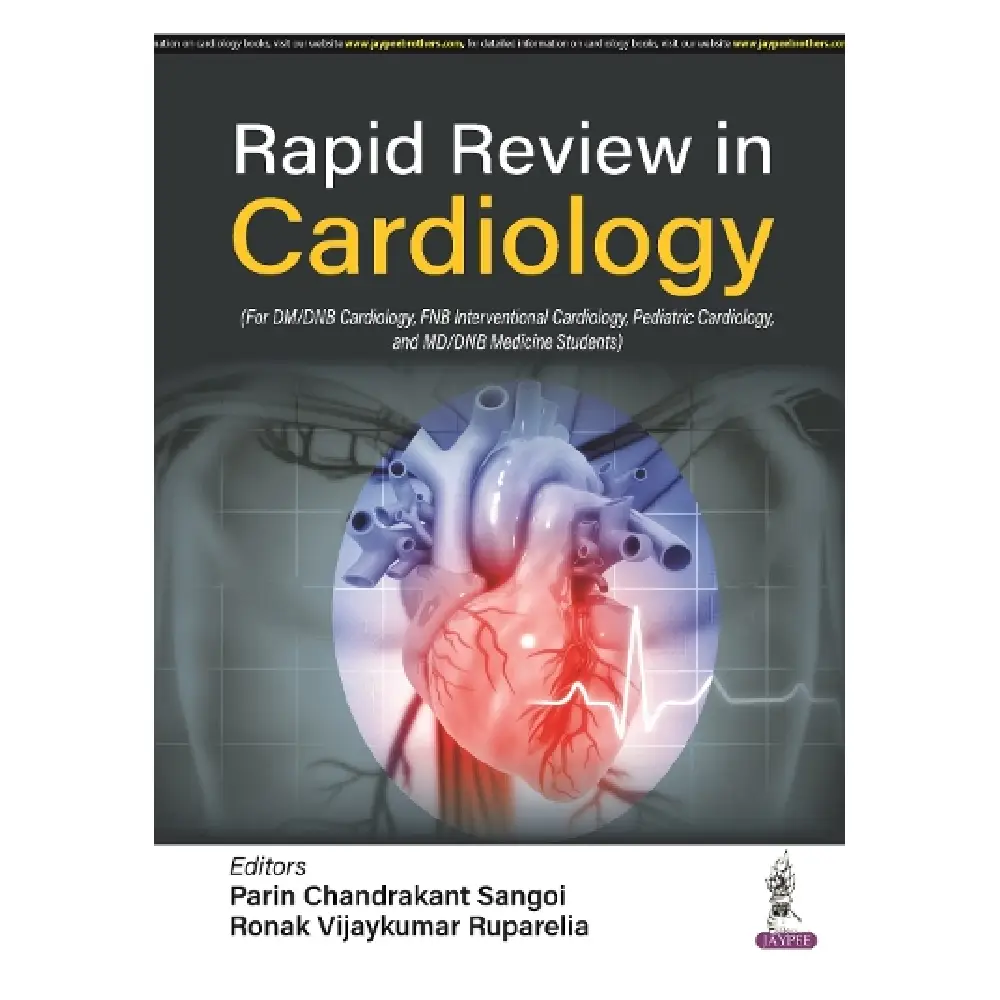
Rapid Review in Cardiology
Rapid review in cardiology is an essential approach for medical students, residents, practicing physicians, and candidates preparing for competitive or board examinations. Cardiology is a vast and dynamic specialty encompassing anatomy, physiology, pathology, pharmacology, diagnostics, and interventional procedures related to the cardiovascular system. A rapid review format condenses high-yield information into concise, structured content that enhances quick revision, retention, and clinical application.
Importance of Rapid Review in Cardiology
Cardiovascular diseases remain the leading cause of morbidity and mortality worldwide. A strong understanding of cardiology is therefore crucial for healthcare professionals. Rapid review materials are designed to summarize core concepts, highlight frequently tested topics, and reinforce clinical reasoning skills. They are particularly useful before examinations, ward rounds, viva voce, or emergency clinical situations where quick recall of essential facts is required.
Rapid review focuses on clarity and precision. Instead of lengthy theoretical discussions, it emphasizes bullet points, flowcharts, algorithms, tables, mnemonics, and case-based scenarios. This structured presentation makes complex topics easier to grasp and revise efficiently.
Core Areas Covered in Rapid Review
A comprehensive rapid review in cardiology typically includes the following major domains:
1. Cardiovascular Anatomy and Physiology
Understanding the structure and function of the heart is fundamental. Key areas include:
-
Cardiac chambers and valves
-
Coronary circulation
-
Cardiac cycle and heart sounds
-
Electrical conduction system
-
Hemodynamics and blood pressure regulation
High-yield topics often include pressure-volume loops, determinants of cardiac output, and mechanisms of heart sound abnormalities.
2. Electrocardiography (ECG)
ECG interpretation is a cornerstone of cardiology. Rapid review resources focus on:
-
Systematic ECG interpretation approach
-
Normal ECG parameters
-
Arrhythmias (atrial fibrillation, atrial flutter, SVT, VT, VF)
-
Heart blocks (first-degree, Mobitz I and II, complete heart block)
-
Ischemic changes and myocardial infarction patterns
-
Electrolyte abnormalities
Mnemonic devices and pattern recognition strategies are frequently included to facilitate quick identification of abnormalities.
3. Ischemic Heart Disease
Coronary artery disease (CAD) is one of the most tested and clinically significant topics. Rapid review includes:
-
Risk factors (modifiable and non-modifiable)
-
Stable angina vs unstable angina
-
NSTEMI vs STEMI
-
Cardiac biomarkers (Troponin, CK-MB)
-
Management protocols (MONA-B, dual antiplatelet therapy, PCI, thrombolysis)
Algorithms for acute coronary syndrome (ACS) management are particularly valuable for quick recall.
4. Heart Failure
Heart failure is categorized into:
-
HFrEF (reduced ejection fraction)
-
HFpEF (preserved ejection fraction)
Rapid review highlights:
-
Pathophysiology
-
Clinical features (left vs right heart failure)
-
Diagnostic tools (BNP, echocardiography)
-
Guideline-directed medical therapy (ACE inhibitors, ARBs, beta-blockers, MRAs, SGLT2 inhibitors)
-
Acute vs chronic management
Tables comparing drugs, indications, and contraindications are commonly included.
5. Valvular Heart Disease
Key conditions include:
-
Mitral stenosis and regurgitation
-
Aortic stenosis and regurgitation
-
Tricuspid valve disorders
Rapid review emphasizes characteristic murmurs, radiation patterns, clinical signs, and indications for surgical or transcatheter intervention.
6. Hypertension
Hypertension is frequently tested and widely prevalent. Important aspects include:
-
Classification (normal, elevated, Stage 1, Stage 2)
-
Secondary causes
-
Hypertensive emergencies vs urgencies
-
First-line medications
-
Lifestyle modifications
Clear treatment algorithms enhance quick decision-making skills.
7. Cardiomyopathies
-
Dilated cardiomyopathy
-
Hypertrophic cardiomyopathy
-
Restrictive cardiomyopathy
Rapid review highlights distinguishing features, genetic associations, and management strategies.
8. Pericardial Diseases
-
Acute pericarditis
-
Pericardial effusion
-
Cardiac tamponade
Classic findings such as Beck’s triad and ECG changes are emphasized.
9. Congenital Heart Disease
Common congenital conditions include:
-
Atrial septal defect (ASD)
-
Ventricular septal defect (VSD)
-
Patent ductus arteriosus (PDA)
-
Tetralogy of Fallot
Rapid review materials often classify congenital heart diseases into cyanotic and acyanotic types for easier understanding.
Diagnostic Modalities in Rapid Review
Cardiology relies heavily on diagnostic investigations. High-yield summaries include:
-
Echocardiography
-
Stress testing
-
Cardiac catheterization
-
CT coronary angiography
-
Cardiac MRI
Indications, advantages, and limitations are typically presented in tabular form.
Pharmacology in Cardiology
Understanding cardiovascular pharmacology is critical. Rapid review commonly includes:
-
Antiarrhythmics (Vaughan-Williams classification)
-
Antihypertensives
-
Antiplatelet agents
-
Anticoagulants
-
Lipid-lowering drugs
Side effects, contraindications, and mechanisms of action are highlighted concisely.
Benefits of Rapid Review Format
-
Time-efficient learning – Ideal for last-minute preparation.
-
High-yield focus – Concentrates on frequently examined topics.
-
Improved retention – Structured formats aid memory.
-
Clinical relevance – Emphasizes practical decision-making.
-
Portability – Often available as compact handbooks or digital summaries.
Who Can Benefit?
-
Undergraduate medical students
-
Postgraduate trainees
-
Cardiology residents
-
Nurses and physician assistants
-
Practicing clinicians refreshing their knowledge
Conclusion
Rapid review in cardiology serves as an invaluable educational tool that simplifies complex cardiovascular concepts into concise, high-impact summaries. By focusing on essential facts, clinical algorithms, ECG interpretation, pharmacology, and management guidelines, it enhances both exam performance and real-world clinical competence. In a field as expansive and evolving as cardiology, rapid review resources provide clarity, efficiency, and confidence to learners and practitioners alike.

Reviews
There are no reviews yet