
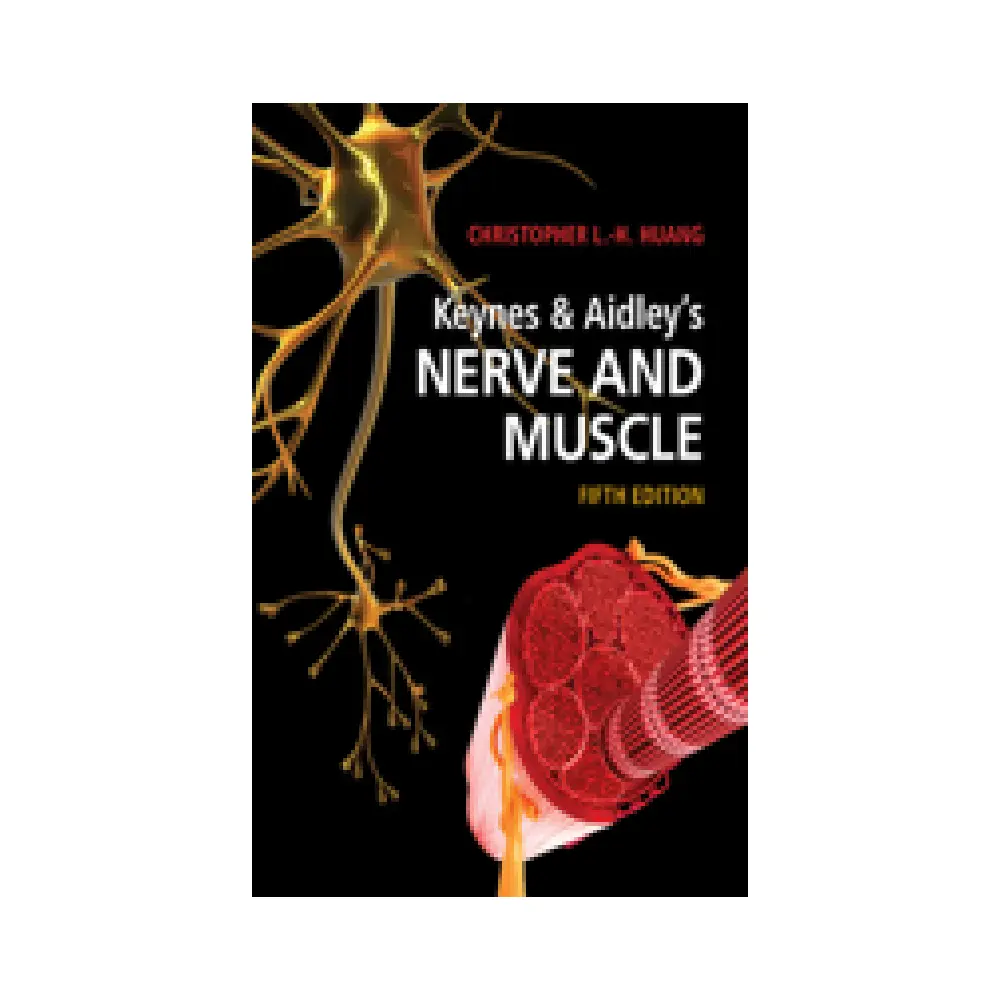


Keynes & Aidley’s Nerve and Muscle: Handbook of General and Clinical Physiology
Keynes & Aidley’s Nerve and Muscle is a classic and widely respected text that provides a deep yet accessible exploration of the physiology of nerves and muscles. Combining foundational science with clinical relevance, the book is designed for medical students, physiology trainees, and clinicians who want to understand not just what happens in excitable tissues, but how and why these processes occur at cellular, molecular, and systems levels. Its emphasis on bioelectric mechanisms and integration of experimental evidence distinguishes it from many standard physiology textbooks.
Foundations of Excitable Tissue Physiology
At its core, the book explains what makes nerve cells and muscle fibers “excitable” — that is, capable of generating and conducting electrical signals. The membrane potential, a defining feature of all neurons and myocytes, arises from the unequal distribution of ions (like sodium, potassium, calcium, and chloride) across the cell membrane. Membrane proteins known as ion channels and pumps maintain these gradients. The Na⁺/K⁺-ATPase pump, for example, continuously transports sodium out and potassium into the cell, helping to establish the resting membrane potential.
The text devotes considerable attention to the biophysical basis of action potentials — the rapid changes in membrane potential that convey information in nerves and trigger contraction in muscles. By walking through depolarization, repolarization, and refractory periods, it clarifies how specific ion channels open and close in precise sequences to produce these signals.
Nerve Physiology
The nervous system section begins with the properties of single neurons and extends to larger networks. Key topics include:
-
Ion channel families and gating kinetics — Understanding voltage-gated sodium and potassium channels explains why action potentials have characteristic shapes and speeds.
-
Propagation of nerve impulses — The book examines how action potentials move along axons, highlighting differences between unmyelinated and myelinated fibers. Myelin dramatically increases conduction velocity by enabling saltatory conduction, where impulses jump between nodes of Ranvier.
-
Synaptic transmission — Chemical synapses, which dominate vertebrate nervous systems, are explained at the level of neurotransmitter release, receptor activation, and postsynaptic responses. The role of calcium influx, vesicle fusion, and receptor subtypes (e.g., nicotinic vs. muscarinic acetylcholine receptors) are discussed with clarity.
-
Sensory and motor pathways — The authors link basic electrophysiology to the functioning of reflex arcs, sensory transduction, and voluntary motor control. This provides context for understanding clinical phenomena such as reflex changes in neuropathy.
Throughout, the text balances molecular mechanisms with system-level function, preparing readers to connect cellular physiology with whole-organ physiology.
Muscle Physiology
The section on muscle begins with skeletal muscle and then covers smooth and cardiac muscle, emphasizing both structural and functional diversity.
Skeletal Muscle
Skeletal muscle contraction results from a highly coordinated interaction between action potentials and the contractile apparatus:
-
Excitation–contraction coupling — This term describes how an electrical signal triggers mechanical force. Depolarization travels down the T-tubule system, activating dihydropyridine receptors and ryanodine receptors in the sarcoplasmic reticulum, which in turn release calcium.
-
Calcium and the contractile proteins — Calcium binds to troponin, allowing actin–myosin cross-bridges to form. The sliding filament model — actin filaments sliding past myosin — is clearly explained and linked to force generation and muscle shortening.
-
Twitch and tetanus — The authors explore how single electrical stimuli produce a “twitch” and how high-frequency stimulation produces tetanus, integrating concepts of summation and fatigue.
Cardiac and Smooth Muscle
Cardiac muscle shares features with both nerve and skeletal muscle but has unique properties such as autorhythmicity and a prolonged action potential mediated by calcium influx. Smooth muscle, found in vessels and hollow organs, contracts through mechanisms modulated by calcium-calmodulin and myosin light-chain kinase, which differ from skeletal muscle regulation. These distinctions help explain physiological responses like vasoconstriction, peristalsis, and cardiac rhythm.
Integration with Clinical Physiology
One of the strengths of Nerve and Muscle is its clear linkage between basic science and clinical conditions. Examples include:
-
Neuropathies and channelopathies — Disorders like myotonia, periodic paralysis, and certain forms of epilepsy are rooted in dysfunctional ion channels. By understanding normal channel function, readers can appreciate how specific mutations alter excitability.
-
Neuromuscular junction disorders — Conditions like myasthenia gravis, where antibodies target acetylcholine receptors, are discussed in terms of impaired transmission, with explanations of how this translates into muscle weakness.
-
Cardiac arrhythmias — Abnormalities in ion channels or conduction pathways are linked to arrhythmogenesis. The book connects membrane currents with ECG findings and therapeutic targets such as antiarrhythmic drugs.
Pedagogical Features
The book uses clear figures, diagrams, and plotted membrane potential traces to illustrate key concepts. Mathematical descriptions (e.g., of membrane current–voltage relationships) are kept at a level appropriate for learners who have basic familiarity with calculus and physics, yet the authors consistently highlight physiological meaning over mathematical formality.
A hallmark of the text is the integration of experimental evidence — classic experiments are revisited to demonstrate how core principles were discovered, fostering a deeper appreciation for scientific reasoning.
Conclusion
Keynes & Aidley’s Nerve and Muscle remains an essential text for anyone seeking an in-depth, rigorous, and integrated understanding of excitable tissues. Its balance of foundational mechanisms, systems physiology, and clinical relevance makes it valuable not only for students preparing for advanced examinations but also for clinicians who wish to strengthen their conceptual framework linking molecular events with physiological function and disease.





Reviews
There are no reviews yet