
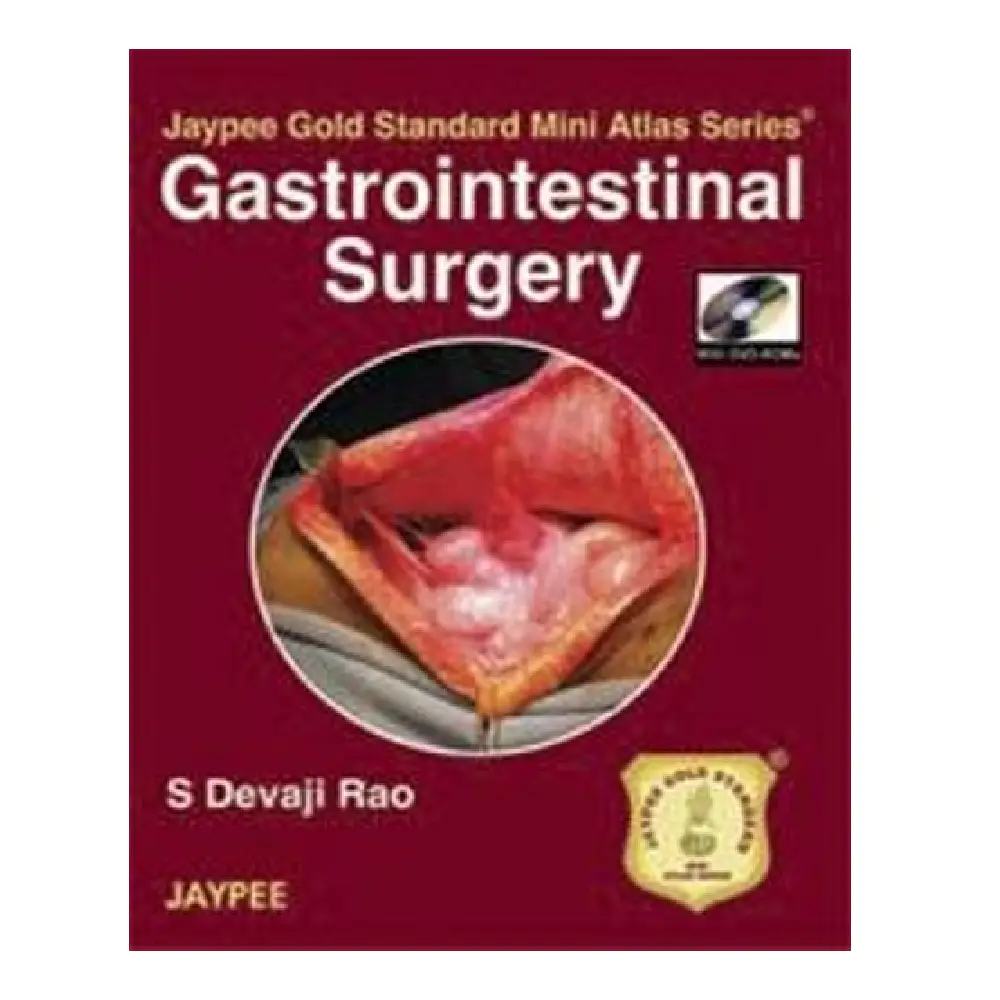
Jaypee Gold Standard Mini Atlas Series: Gastrointestinal Surgery
Jaypee Gold Standard Mini Atlas Series: Gastrointestinal Surgery is a comprehensive, full-colour surgical atlas focused on gastrointestinal (GI) surgery. It is published by Jaypee Brothers Medical Publishers, authored by S. Devaji Rao, and designed as a visual, practical reference aimed at general surgeons, surgical residents, and postgraduate trainees. The book blends detailed illustrations, photographs, clinical algorithms, and step-by-step descriptions of surgical procedures with perioperative decision-making guides.
This atlas serves both as a learning tool and a ready reference, covering fundamental GI procedures — from basic operative techniques to management of complications — while emphasizing visual clarity to bridge theory and practice.
Structure and Content
Although precise chapter titles vary with editions, the atlas broadly covers the entire spectrum of gastrointestinal surgery in a systematic, logically organized format:
1. Foundations of GI Surgery and Operative Principles
The atlas begins with general surgical principles applicable to the GI tract, including preoperative evaluation, surgical anatomy, and operative planning. It uses diagrams and operative photographs to reinforce correct tissue planes, essential anatomical landmarks, and safe operative approaches. This foundational section ensures that learners understand not only what to do, but why each step is important in the context of the surgical field.
2. Upper GI Tract Procedures
A significant portion of the book addresses surgeries of the esophagus and stomach — including oesophagectomies, gastrectomies, vagotomies, and management of post-operative complications. For each procedure, the atlas provides:
-
Indications and contraindications
-
Operative steps with high-resolution illustrations
-
Intraoperative decision points
-
Postoperative outcomes and possible complications
For example, operations like esophageal resection are laid out with clear diagrams depicting approaches (e.g., transhiatal vs. transthoracic) and reconstructions, as well as typical postoperative issues such as anastomotic leaks or dysphagia.
3. Small and Large Bowel Surgery
The core of GI surgery — bowel resection and anastomosis — is covered in extensive detail. Topics include:
-
Small bowel resection
-
Management of intestinal obstruction
-
Identification and treatment of fistulae
-
Colonic resections and stomas
For each clinical scenario, the atlas explains indications, operative techniques, and postoperative complications such as leakage, obstruction, or stoma problems — often accompanied by radiographic images or intraoperative photos to aid comprehension.
4. Appendectomy and Emergency GI Operations
The atlas reviews common urgent procedures like appendectomy with illustrations showing:
-
Common complications (e.g., stump rupture)
-
Wound infection management
-
Decision-making in cases of complicated appendicitis
This section is particularly valuable for trainees managing acute surgical emergencies where visual cues help to prevent errors.
5. Colostomy and Ileostomy Techniques
Stomas are a crucial part of GI surgery, and the atlas provides visual guidance on:
-
Proper stoma creation
-
Management of complications like prolapse, stenosis, and parastomal hernia
-
Troubleshooting common postoperative problems
Detailed clinical photos and diagrams help surgeons plan and execute stoma procedures with minimal morbidity.
6. Hepatobiliary Procedures
Although the main focus is gastrointestinal, the atlas also includes surgical aspects of the gallbladder and biliary tree. It discusses:
-
Cholecystectomy (open and laparoscopic)
-
Common bile duct exploration
-
Management of retained stones or strictures
-
Complications and postoperative care
Visual step-by-step guidance is especially helpful for residents less familiar with hepatobiliary anatomy or intraoperative nuances.
Features and Pedagogical Strengths
Several elements distinguish this atlas as an effective educational resource:
Illustrations and Photographs
High-quality drawings and intraoperative images dominate the text, transforming complex procedures into easy-to-interpret visual sequences. This visual emphasis allows learners to grasp technical nuances more quickly than with text alone.
Clinical Algorithms
The atlas includes clear preoperative and postoperative algorithms, helping readers decide the best management path for common GI problems — particularly useful in busy clinical settings or exam preparation.
Discussion of Complications
Beyond just showing how to operate, the book explains recognition and management of intra- and postoperative complications, such as leaks, obstruction, fistulae, and infection — essential knowledge for safe surgical practice.
Supplementary DVD Content
Some editions include a DVD-ROM showing real surgical videos (e.g., gastrectomy mobilization, laparoscopic cholecystectomy, liver resections) to complement the atlas visuals — invaluable for kinaesthetic learners and those preparing for operative responsibilities.
Audience and Use Cases
This atlas is especially suited for:
-
General surgery residents and trainees
-
Medical students on surgical rotations
-
Practicing surgeons seeking a quick procedural reference
-
Exam preparation (postgraduate surgical examinations)
Its compact, visual format makes it a practical supplement to larger surgical textbooks, offering quick reinforcement of key principles and surgical techniques in gastrointestinal surgery.
Summary
Jaypee Gold Standard Mini Atlas Series: Gastrointestinal Surgery is a richly illustrated, clinically oriented atlas that combines visual learning, procedural guidance, and practical management algorithms. It bridges the gap between theoretical surgical knowledge and real-world operative scenarios, making it a valuable resource for both novice and experienced surgeons alike.






Reviews
There are no reviews yet