
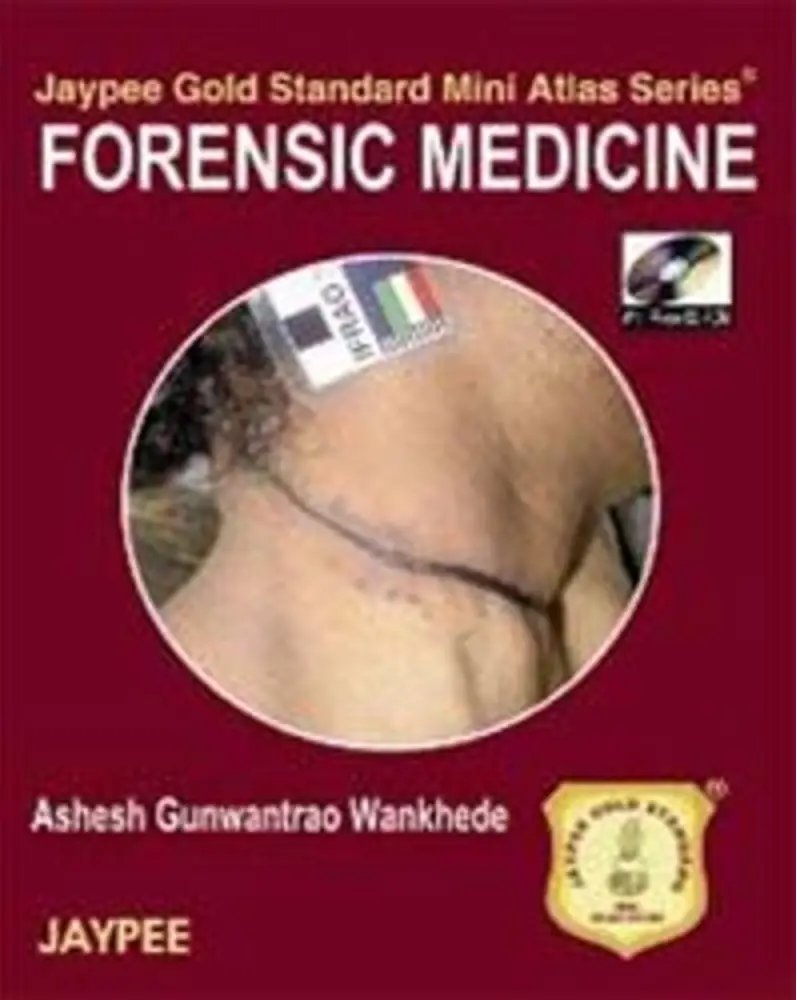
Jaypee Gold Standard Mini Atlas Series: Forensic Medicine is a concise, illustrated reference book designed to help medical students and healthcare professionals understand the essential concepts of forensic medicine through clear images and simplified explanations. Written by Ashesh Gunwantrao Wankhede and A. G. Wankhede, the book is part of the well-known Jaypee Gold Standard Mini Atlas Series published by Jaypee Brothers Medical Publishers. The atlas format emphasizes visual learning, making complex medico-legal topics easier to grasp for students and practitioners.
This book was first published in 2008 and contains approximately 350–380 pages of concise material presented in a pocket-sized format. It is written in clear academic English and designed primarily for undergraduate medical students, postgraduate trainees, and doctors who need a quick reference in forensic medicine and clinical forensic practice.
Structure and Content
The text is divided into two main sections: Morbid Forensic Medicine and Clinical Forensic Medicine. This structure helps readers understand both the theoretical and practical aspects of the discipline. The first section focuses on postmortem findings and forensic pathology, while the second covers medico-legal examination of living individuals.
In the Morbid Forensic Medicine section, the atlas introduces fundamental topics such as identification of the dead, examination of clothing and personal articles, and recognition of bodily changes after death. It explains various postmortem phenomena like rigor mortis, livor mortis, and decomposition. These topics are essential for determining the time and cause of death during forensic investigations. The book also discusses injuries caused by physical factors such as fire, electricity, and starvation.
Another important topic included in this section is poisoning, which is a major area of forensic toxicology. The atlas illustrates different types of poisons, their effects on the body, and the medico-legal significance of toxic substances. It also addresses forensic aspects related to fetal death and examination of sexual assault injuries, which are highly relevant in criminal investigations.
The Clinical Forensic Medicine section deals with the examination of living individuals in medico-legal situations. This includes determination of age, examination of injured persons, and documentation of physical abuse. It also covers the medico-legal evaluation of individuals involved in sexual offences and the examination of weapons that may have caused injuries. Additionally, the book provides guidance on the assessment of drunkenness and intoxication, which is often required in legal cases such as traffic accidents or criminal offences.
Visual Learning and Illustrations
One of the major strengths of this atlas is its extensive use of clinical photographs, diagrams, and labelled illustrations. These images help students recognize different types of injuries, forensic signs, and pathological changes. The visual approach is particularly valuable in forensic medicine because many medico-legal conclusions depend on the accurate interpretation of physical evidence.
Some editions of the book also include a photo CD-ROM, which provides additional images and learning material to supplement the printed text. This feature enhances the educational value of the atlas by allowing learners to review high-quality visual references outside the classroom.
Educational Value
The atlas is widely appreciated for its compact size and straightforward presentation. Unlike large forensic textbooks, it focuses on key concepts and visual recognition, making it ideal for quick revision. Medical students preparing for examinations often use it as a supplementary resource alongside comprehensive forensic medicine textbooks.
It is also helpful for general practitioners, emergency physicians, and medico-legal experts who require rapid reference to forensic findings and procedures. Because the book condenses essential information into short descriptions supported by images, it enables readers to review important topics efficiently.
Conclusion
Overall, Jaypee Gold Standard Mini Atlas Series: Forensic Medicine serves as a practical visual guide to the principles of forensic medicine. By combining concise explanations with detailed illustrations, the atlas simplifies complex medico-legal concepts and enhances understanding of forensic pathology and clinical forensic examination. Its portability, clarity, and visual emphasis make it a valuable learning resource for medical students, forensic specialists, and healthcare professionals involved in medico-legal practice.



Reviews
There are no reviews yet