
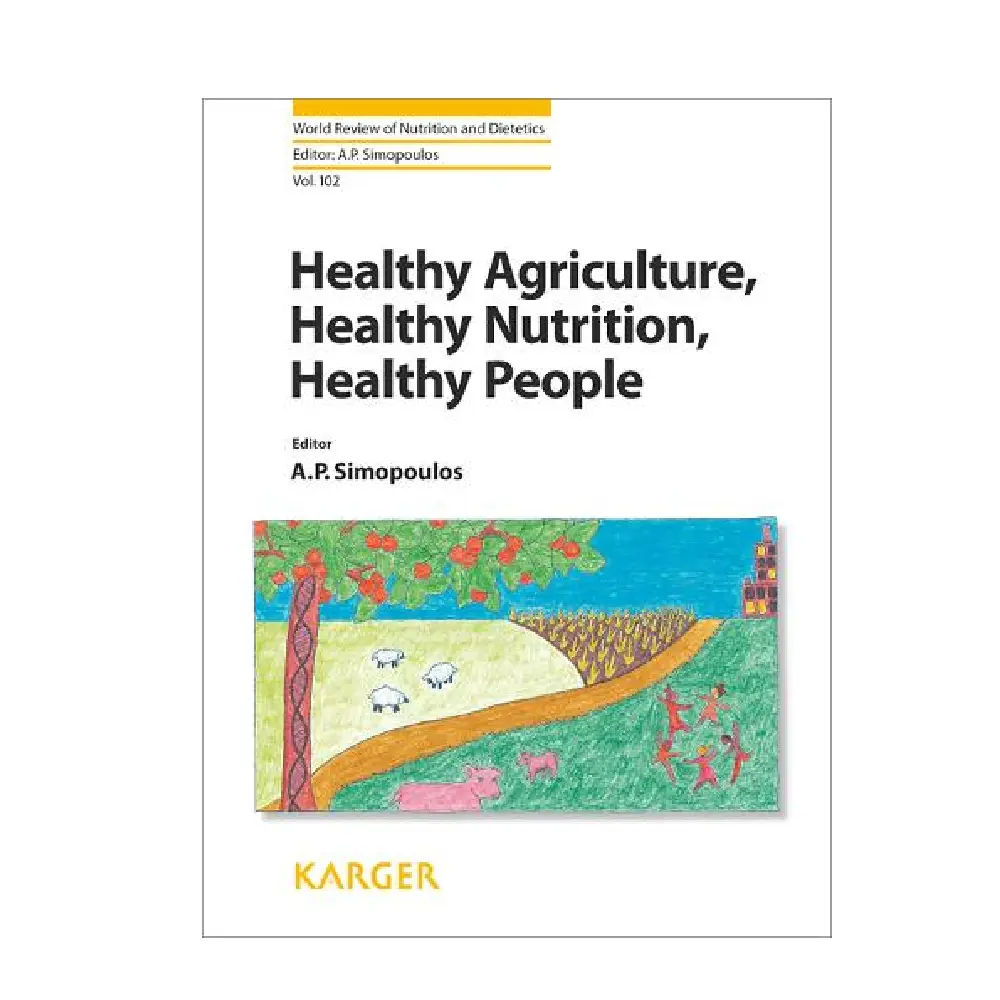

Healthy Agriculture, Healthy Nutrition, Healthy People is a comprehensive and timely volume in the World Review of Nutrition and Dietetics series (Volume 102), published by S. Karger AG. It tackles the interconnectedness of agricultural systems, nutritional quality, and human health—a theme of global importance in the 21st century. As the world grapples with multiple public health challenges, including malnutrition, obesity, non-communicable diseases, and climate change, this book brings together multidisciplinary scientific insights that trace the pathways from soil to society and illustrate how agriculture practices directly influence nutrition outcomes and, ultimately, population health.
At its core, the book emphasizes that healthy agriculture is fundamental to healthy nutrition, which in turn is necessary for healthy people. This nexus counters reductionist views that treat food solely as a commodity or calorie source; instead, it underscores food’s role as a provider of essential nutrients and bioactive compounds that shape physiological functions and disease risk. The text advocates for agricultural systems that produce food of high nutritional quality while preserving environmental sustainability and equitable access.
One of the central themes of the book is the evolution of agricultural practices and their nutritional implications. Traditional food systems were often characterized by biodiversity, seasonal diets, and localized production. Over the past century, however, industrialized agriculture has prioritized yield and uniformity over nutrient density, leading to landscapes dominated by monocultures such as wheat, maize, and soy. Contributors explain how this shift has affected nutrient profiles of staple foods and has limited the availability of micronutrient-rich fruits, vegetables, and legumes in many regions. Scientific evidence presented in the book links declines in soil quality and microbial diversity—often the result of intensive chemical inputs—with reductions in the micronutrient content of crops. These changes have implications for human health, as deficient intake of vitamins and minerals is associated with anemia, impaired immunity, and increased risk of chronic diseases.
The volume also examines agricultural innovations and their potential to improve nutrition. Agroecology, organic farming, and regenerative practices are discussed as strategies that enhance soil health and biodiversity, sequester carbon, and produce nutrient-dense foods. Case studies illustrate how diversified cropping systems—such as intercropping and crop rotations—can improve dietary diversity among farming communities while enhancing resilience to climate variability. These approaches are presented not as nostalgic ideals but as scientifically grounded, scalable options that align agricultural productivity with human health goals.
Nutrition experts in the book delve into dietary quality and public health outcomes. They explore how diets rich in whole grains, legumes, fruits, vegetables, and healthy fats are associated with lower rates of obesity, cardiovascular disease, type 2 diabetes, and certain cancers. By juxtaposing dietary patterns across populations, the authors show that health outcomes are better in regions where diets remain closely tied to traditional, minimally processed foods. In contrast, the global spread of ultraprocessed foods—high in refined sugars, unhealthy fats, and sodium—has contributed to rising rates of metabolic disorders even in low- and middle-income countries.
Importantly, the book highlights the socioeconomic determinants of agriculture, nutrition, and health. Poverty, food insecurity, and inequitable food distribution are identified as major barriers to achieving healthy diets for all. Contributors argue that policy interventions must go beyond agricultural subsidies for commodity crops to support production and distribution of diverse, nutrient-rich foods. They point to successful examples of food policy councils, school feeding programs that source from local farms, and fiscal measures such as taxes on sugar-sweetened beverages. These multidisciplinary policy discussions reinforce the idea that agriculture and nutrition cannot be siloed but must be integrated into broader public health and economic strategies.
Throughout the text, scientific evidence is presented with clarity and depth. Epidemiological studies, randomized trials, and mechanistic research are used to demonstrate how food quality affects biomarkers of health, immune function, and metabolic pathways. The book also addresses emerging concerns such as the impact of climate change on food systems, including how shifts in temperature and precipitation affect crop yields and nutritional composition. The authors advocate for climate-smart agricultural practices that not only reduce greenhouse gas emissions but also enhance the production of foods that support human health.
One of the greatest strengths of Healthy Agriculture, Healthy Nutrition, Healthy People is its holistic perspective. It brings together agronomists, nutritionists, public health professionals, and policy experts to illustrate that health outcomes are shaped by decisions made far upstream in food production and distribution systems. This interdisciplinary approach challenges readers to think beyond individual dietary choices to consider structural determinants of nutrition and health.
While the book provides a robust scientific foundation, it also serves as a call to action. It urges stakeholders—including policymakers, farmers, health professionals, and consumers—to recognize their roles in shaping food systems that support wellbeing. By articulating clear linkages between agricultural practices and health outcomes, the book contributes to an emerging paradigm in nutrition science that values sustainability, equity, and evidence-based policymaking.
In conclusion, Healthy Agriculture, Healthy Nutrition, Healthy People is a vital resource for anyone seeking to understand the complex relationships among food production, dietary quality, and public health. Its comprehensive coverage of biological, environmental, social, and policy dimensions makes it indispensable for researchers, practitioners, and decision-makers committed to creating a healthier, more sustainable future.

Reviews
There are no reviews yet