
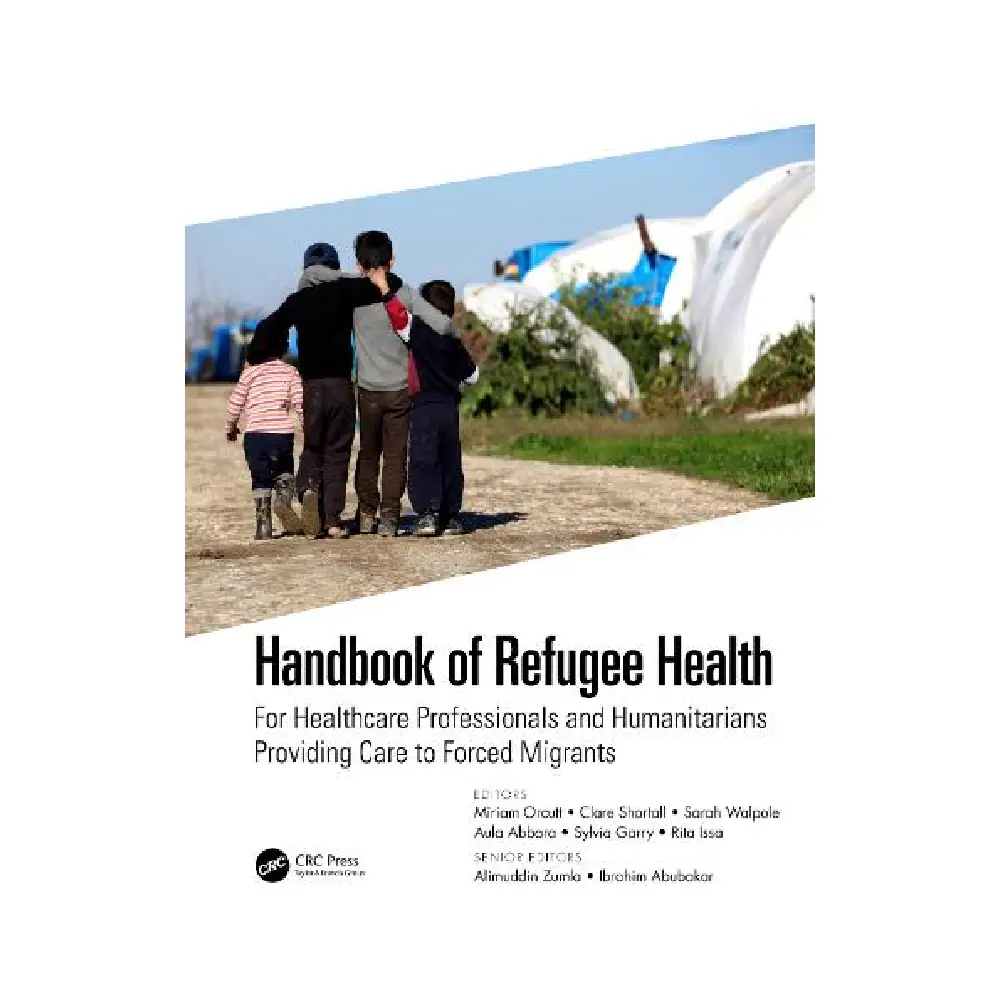

Handbook of Refugee Health
Handbook of Refugee Health: For Healthcare Professionals and Humanitarians Providing Care to Forced Migrants is a comprehensive, multidisciplinary resource designed to inform clinicians, public health practitioners, humanitarian workers, policy makers, and researchers about the complex health needs of refugees and forcibly displaced populations. The text synthesizes public health theory, applied practice, and clinical approaches within the context of forced migration, equipping readers with evidence-based guidance and practical tools for delivering health services in diverse settings around the world.
Authorship and Purpose
The book is a collaborative work edited by Miriam Orcutt, Clare Shortall, Sarah Walpole, with contributions from experts including Aula Abbara, Sylvia Garry, Rita Issa, Alimuddin Zumla, and Ibrahim Abubakar – all of whom bring extensive experience in global health, humanitarian practice, clinical medicine, and migration research. It was published in 2021 by CRC Press (Taylor & Francis Ltd) as a first edition paperback.
The handbook aims to bridge the gap between academic literature on refugee health and practical health management in humanitarian emergencies. It acknowledges that health provision for refugees often occurs in unstable, resource-limited environments where conventional biomedical models have limited applicability. By integrating socio-ecological frameworks with clinical practice, the book helps users navigate the layered determinants of health in forced migration contexts.
Structure and Content
The book is organized into three major sections — (1) Public Health Theory, (2) Applied Public Health, and (3) Clinical Approaches — reflecting a progression from broad conceptual understanding to actionable practice and clinical care.
-
Public Health Theory:
This section lays the groundwork for understanding forced migration and health by defining key concepts such as migration dynamics, global health governance, international standards, human rights, and humanitarian principles. It situates refugee health within global policy frameworks and discusses how social determinants — including displacement drivers, legal status, and access barriers — shape health outcomes. By emphasizing a rights-based approach, the text underscores that refugees are entitled to equitable health services and protections regardless of context. -
Applied Public Health:
Here, the focus shifts to implementing public health strategies in displacement settings. Topics include health needs assessments in camp and urban settings, health systems strengthening, mainstreaming refugee health within national systems, and improving access to services. Vulnerable subpopulations — such as children, women, older adults, persons with disabilities, and survivors of violence — are discussed with special attention to tailored interventions, safeguarding, and integrated support services. The section also explores the role of health policy, advocacy, and coordination mechanisms such as the Health Cluster in humanitarian responses. -
Clinical Approaches:
The final and most detailed section examines clinical care for refugees across a wide spectrum of conditions. It includes emergency care principles, triage, communicable diseases (e.g., respiratory infections, HIV care, tropical diseases, sepsis), non-communicable diseases (e.g., cardiovascular, endocrine, neurological conditions), mental health and psychosocial support, maternal and reproductive health, paediatrics, and palliative care. The chapter on mental health emphasizes cultural context and the psychosocial effects of trauma, displacement stressors, and loss. The clinical chapters balance globally relevant disease patterns with care strategies adaptable to high- and low-resource environments.
Key Features and Approach
A major strength of this handbook is its holistic, systems-based perspective — recognizing that refugee health cannot be addressed solely through clinical interventions but must integrate social, economic, cultural, and political factors. It moves beyond checklist-style medical manuals to provide contextually nuanced frameworks that promote equity, dignity, and rights in healthcare delivery.
-
Interdisciplinary Integration: The book brings together insights from public health, clinical medicine, anthropology, human rights law, health systems research, and humanitarian practice. This makes it relevant not just for clinicians, but also for planners, implementers, and policy makers.
-
Practical Guidance: While grounded in theory, the text is rich in real-world application — offering practical assessment tools, service mapping strategies, coordination mechanisms, and culturally sensitive care practices.
-
Global Relevance: Although many examples draw on low- and middle-income country settings where forced migration is most prevalent, the principles and frameworks are applicable to high-resource contexts facing refugee influxes, resettlement health challenges, and border health management.
Target Audience
The book is intended for:
-
Healthcare Professionals: Doctors, nurses, and allied health workers involved in refugee health and humanitarian response.
-
Public Health Practitioners: Those working in health policy, program management, surveillance, and health system strengthening.
-
Humanitarian Workers: Field staff and coordinators engaged in health cluster management, emergency response, and multisectoral service delivery.
-
Students and Researchers: Learners in global health, migration studies, epidemiology, and social medicine who seek a comprehensive, multidisciplinary reference.
Conclusion
Handbook of Refugee Health offers a compelling blend of theory and practice designed to support effective, equity-oriented healthcare for forced migrants in diverse environments. Its structured approach—from foundational public health concepts through applied strategies and clinical care—makes it both an informative educational text and a practical reference for frontline responders and policy makers working in the challenging domain of refugee health.





Reviews
There are no reviews yet