
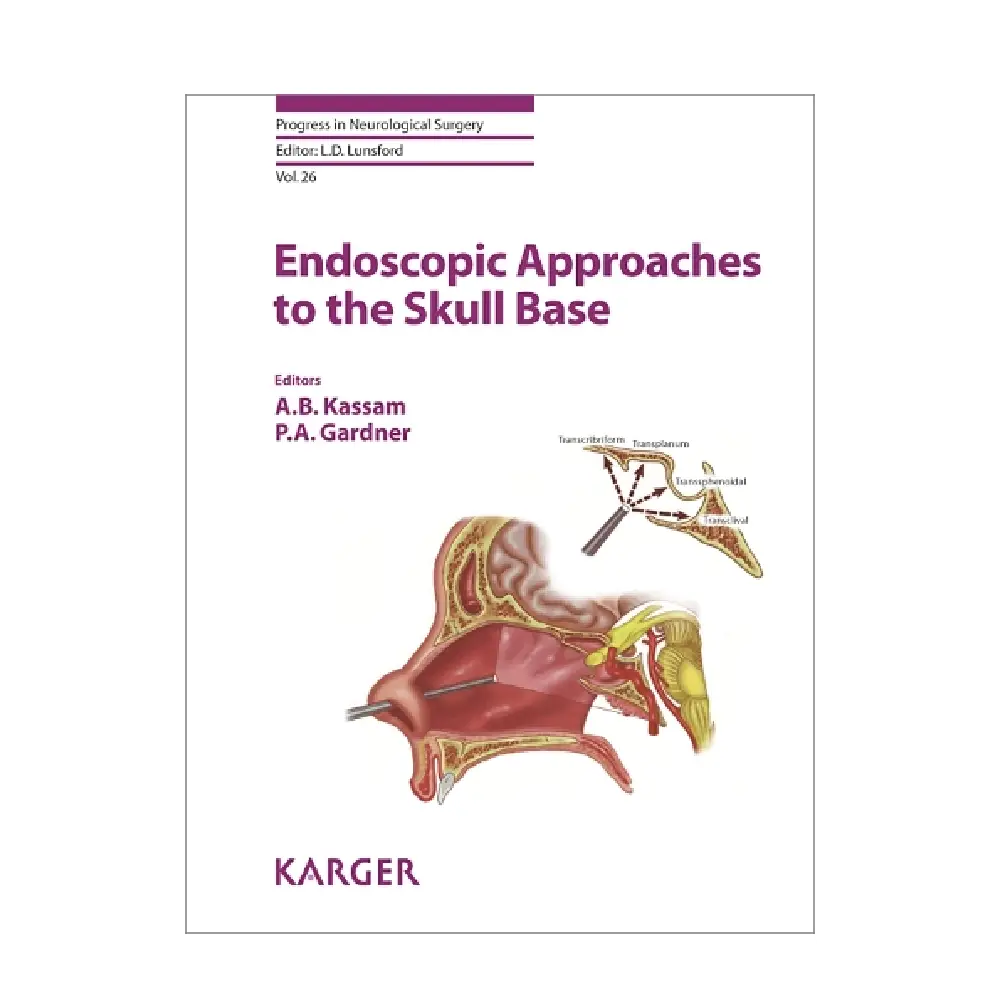


Endoscopic Approaches to the Skull Base
(Progress in Neurological Surgery, Volume 26)
Endoscopic Approaches to the Skull Base is a comprehensive and authoritative surgical reference that examines the evolution, techniques, indications, and outcomes of endoscopic surgery for skull base pathologies. Part of the Progress in Neurological Surgery series (Volume 26), this book is geared toward neurosurgeons, otolaryngologists, skull base surgeons, residents, and allied professionals who manage complex tumors and disorders involving the anterior, middle, and posterior skull base.
Traditionally, surgical access to the skull base—a deep, anatomically complex area at the base of the brain—required large, invasive craniotomies and extensive tissue dissection. Over the past few decades, however, advances in endoscopic technology have revolutionized skull base surgery. High-resolution optics, angled lenses, refined instrumentation, and improved surgical navigation systems now allow surgeons to reach deep regions through natural corridors such as the nasal passages. Endoscopic approaches minimize brain retraction and trauma, reduce postoperative pain, shorten recovery time, and often preserve neurological function.
This volume brings together expert contributors from across the globe. It combines anatomical insights, surgical strategies, clinical case series, and outcome analysis to provide a coherent and practical guide to endoscopic skull base surgery.
Historical Evolution and Rationale
The book begins by outlining the historical progression of skull base access. Early pioneers explored transnasal routes using rigid endoscopes originally developed for sinus surgery. With refinement of endoscopic optics and instruments, this approach progressively expanded from sinonasal procedures into neurosurgical applications.
The authors emphasize that successful endoscopic skull base surgery requires mastery of three foundational elements: detailed knowledge of skull base anatomy; precise preoperative assessment; and technical expertise with endoscopic tools. The synergy of neurosurgical and otolaryngological techniques—often in a collaborative team setting—is a recurring theme throughout the book.
Anatomical Landmarks and Surgical Planning
One of the strengths of this text is its rigorous focus on anatomy. Endoscopic skull base surgery demands not only three-dimensional spatial awareness but also an understanding of neurovascular relationships that can vary between individuals.
The book reviews key anatomical areas, including:
-
Anterior skull base: ethmoid roof, cribriform plate, planum sphenoidale, and orbital roofs
-
Middle skull base: sphenoid sinus, cavernous sinus, and petrous apex
-
Posterior skull base: clivus, foramen magnum region, and brainstem corridors
Detailed illustrations and surgical mapping techniques help surgeons visualize operative corridors. The role of advanced imaging—such as CT, MRI, and fused image navigation—is stressed as a cornerstone of preoperative planning. Digital surgical navigation and intraoperative neuromonitoring are presented as tools that enhance precision and reduce risks to critical structures.
Endoscopic Approaches by Region
The core of the book is dedicated to describing region-specific endoscopic approaches:
1. Anterior Skull Base Approaches
These are commonly used for pituitary adenomas, meningiomas of the tuberculum sellae, craniopharyngiomas, and sinonasal tumors with skull base extension. The endoscopic transnasal transsphenoidal approach to the pituitary is perhaps the best known—offering direct access to the sella without the need for a craniotomy.
The authors discuss variations such as the extended endonasal approach, which allows access to suprasellar, parasellar, and clival regions. Techniques for dural opening, tumor debulking, and closure are covered in depth, with emphasis on achieving gross total resection while preserving pituitary and neurological function.
2. Middle Skull Base Approaches
Middle skull base pathologies include chordomas and chondrosarcomas, as well as lesions involving the cavernous sinus and petrous apex. These areas present unique challenges due to proximity to cranial nerves and major blood vessels.
Endoscopic approaches augment traditional transcranial techniques by providing angled access that minimizes manipulation of sensitive structures. Techniques such as lateral sphenoidotomy, transpterygoid approaches, and combined skull base routes are analyzed for indications, benefits, and limitations.
3. Posterior Skull Base Approaches
Endoscopic access to the clivus and foramen magnum has expanded treatment options for clival chordomas, neurenteric cysts, and meningiomas in these regions. The book outlines how a midline endoscopic approach can be used safely to reach these deep areas, with careful attention to carotid artery positioning, lower cranial nerve preservation, and dural repair.
Reconstruction Techniques and CSF Leak Prevention
A major challenge in endoscopic skull base surgery is reconstructing the surgical defect and preventing cerebrospinal fluid (CSF) leaks. The book dedicates several chapters to reconstructive strategies, especially the now-standard nasoseptal flap technique—using the patient’s own vascularized mucosa to create a durable barrier between intracranial and sinonasal spaces.
Researchers discuss adjunctive materials such as collagen matrices, fibrin sealants, grafts, and lumbar drain utilization. The importance of tailoring reconstruction to defect size and location, as well as intraoperative assessment of closure integrity, is emphasized.
Complications, Outcomes, and Evidence
No surgical textbook on high-risk procedures would be complete without a frank discussion of complications. The book reviews common and serious potential adverse outcomes:
-
CSF leaks
-
Meningitis or intracranial infection
-
Vascular injury (e.g., internal carotid artery)
-
Cranial nerve deficits
-
Endocrine dysfunction
Here, the authors do not merely list complications—they analyze risk factors, preventive measures, and evidence-based strategies to manage these issues when they arise.
Outcomes data from multicenter studies, institutional series, and meta-analyses are presented. These sections support the efficacy and safety of endoscopic approaches for selected indications, noting generally favorable results in terms of morbidity, hospital stay, and patient recovery when compared with traditional open approaches.
Future Directions
The book concludes with a look toward future innovations: robotic assistance, 3D endoscopy, augmented reality guidance, and molecular profiling of tumors that may influence surgical decision-making. These emerging technologies are poised to further refine and expand the indications for endoscopic skull base surgery.
Conclusion
Endoscopic Approaches to the Skull Base serves as both a clinical guide and a scholarly reference. Its blend of anatomical precision, step-by-step surgical techniques, practical illustrations, and outcome analysis makes it indispensable for surgeons who perform or are training in advanced endoscopic skull base surgery. By bridging foundational science with real-world clinical application, this volume helps advance both understanding and practice in one of the most dynamic areas of modern neurosurgery.
product details for the book with ISBN 9783805592109:
Title: Endoscopic Approaches to the Skull Base (Progress in Neurological Surgery, Volume 26)
Author / Editors: Edited by Amin B. Kassam and Paul A. Gardner
Edition: 1st Edition
Publisher: S. Karger AG (Basel, Switzerland)
Publication Year: 2012
ISBN: 978-3805592109 (print)
Product Type: Academic / Professional Medical Reference Book
Category: Medicine — Neurosurgery; Endoscopic Skull Base Surgery; Otolaryngology & Head and Neck Surgery
Language: English
Print Length: ~420 pages (approximate; varies by edition/source)



Reviews
There are no reviews yet