
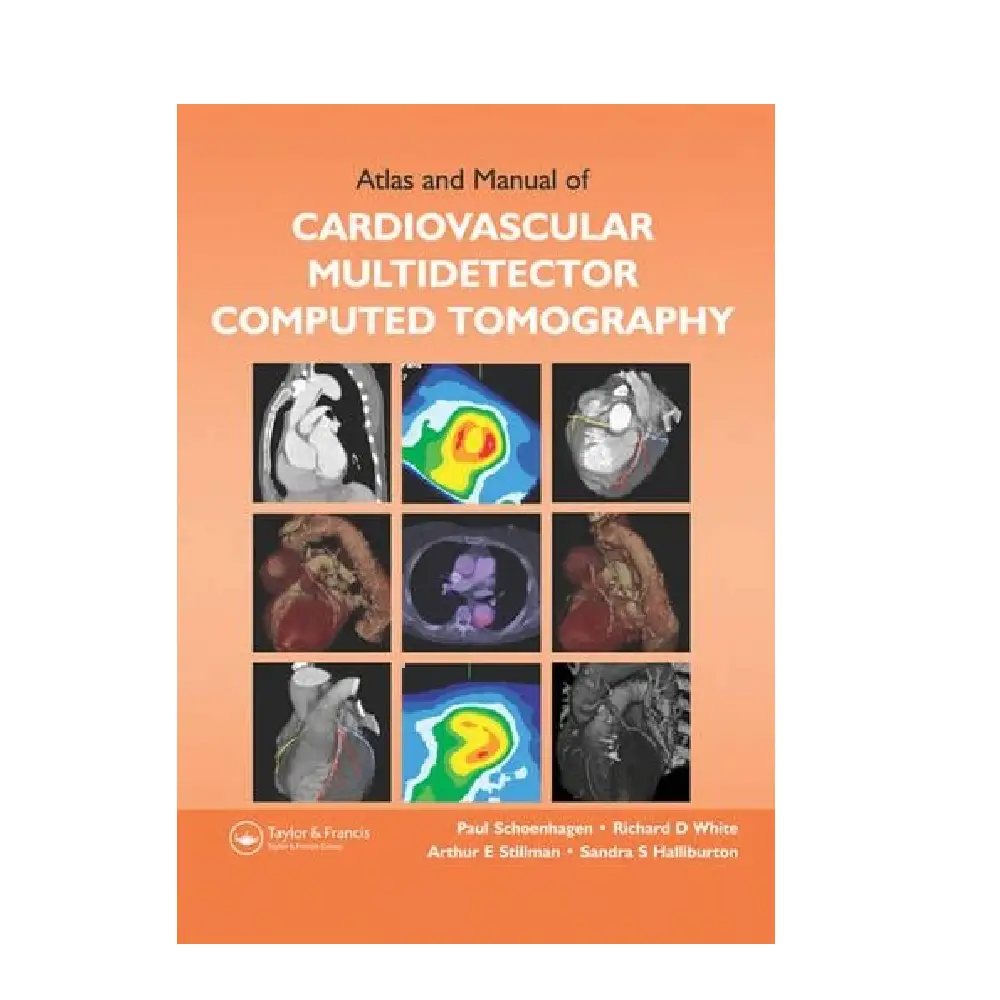


Atlas and Manual of Cardiovascular Multidetector Computed Tomography
Cardiovascular Multidetector Computed Tomography (MDCT) is a highly advanced, non-invasive imaging technique that has transformed the evaluation of cardiac and vascular diseases. The book Atlas and Manual of Cardiovascular Multidetector Computed Tomography by Paul Schoenhagen, Arthur E. Stillman, Sandra S. Halliburton, and Richard D. White provides a comprehensive overview of the principles, techniques, clinical applications, and interpretation of cardiovascular MDCT. It serves as both a practical manual and a visual atlas for cardiologists, radiologists, technologists, and trainees.
Multidetector CT represents a major technological advancement over earlier single-slice CT scanners. By using multiple rows of detectors, MDCT systems can acquire thin, high-resolution slices of the heart within a single breath-hold. This capability is essential in cardiac imaging because the heart is constantly moving. The integration of electrocardiographic (ECG) gating allows synchronization of image acquisition with specific phases of the cardiac cycle, significantly reducing motion artifacts and improving image clarity.
One of the most important clinical applications of cardiovascular MDCT is the evaluation of coronary artery disease (CAD). Coronary CT angiography (CTA) enables visualization of the coronary arteries, detection of stenosis, identification of calcified and non-calcified plaques, and assessment of vessel patency. MDCT has proven particularly valuable in patients with intermediate risk of CAD, where it can help rule out significant coronary obstruction non-invasively. It also plays a crucial role in evaluating coronary anomalies, bypass grafts, and stents.
The atlas emphasizes image acquisition protocols, including patient preparation, heart rate control, contrast administration, and radiation dose optimization. Beta-blockers are often used to reduce heart rate and improve image quality. Proper timing of contrast injection ensures optimal opacification of coronary arteries and cardiac chambers. The book also discusses post-processing techniques such as multiplanar reconstruction (MPR), maximum intensity projection (MIP), and three-dimensional volume rendering, which enhance anatomical visualization and diagnostic accuracy.
Beyond coronary imaging, cardiovascular MDCT is widely used for assessing cardiac morphology and function. It allows accurate evaluation of cardiac chambers, ventricular volumes, myocardial thickness, and pericardial disease. MDCT is particularly useful in the assessment of congenital heart disease, providing detailed anatomical mapping that assists in surgical planning. In patients with suspected pulmonary embolism, CT pulmonary angiography remains the imaging modality of choice due to its speed and high diagnostic sensitivity.
Another major application is imaging of the aorta and great vessels. MDCT is highly effective in diagnosing aortic aneurysm, dissection, intramural hematoma, and penetrating ulcers. The rapid acquisition time makes it especially valuable in emergency settings. In addition, MDCT is used in pre-procedural planning for transcatheter aortic valve replacement (TAVR), allowing precise measurement of the aortic annulus, evaluation of vascular access routes, and identification of anatomical variations.
Radiation exposure is an important consideration in cardiac CT imaging. The manual provides detailed guidance on dose reduction strategies, including prospective ECG-triggered scanning, tube current modulation, and optimization of scan parameters. Advances in scanner technology and reconstruction algorithms have significantly reduced radiation doses while maintaining image quality.
The book is richly illustrated with high-quality images demonstrating normal anatomy, common pathologies, and complex cases. Each chapter combines theoretical explanations with practical examples, making it a valuable learning resource. The atlas format allows readers to compare normal and abnormal findings side by side, enhancing diagnostic confidence.
Cardiovascular MDCT continues to evolve with improvements in detector technology, faster gantry rotation times, and enhanced software capabilities. The integration of artificial intelligence and advanced image reconstruction techniques promises even greater diagnostic precision in the future. As a non-invasive modality, MDCT bridges the gap between traditional diagnostic imaging and invasive coronary angiography, offering detailed anatomical insight with reduced patient risk.
In summary, Atlas and Manual of Cardiovascular Multidetector Computed Tomography provides an in-depth exploration of this powerful imaging modality. It covers technical foundations, clinical indications, image interpretation, and safety considerations in a structured and accessible manner. Cardiovascular MDCT has become an indispensable tool in modern cardiology and radiology, enabling early diagnosis, accurate risk stratification, and improved patient management across a wide spectrum of cardiovascular diseases.




Reviews
There are no reviews yet