
Interventional Cardiology: A Global Perspective — Comprehensive Overview
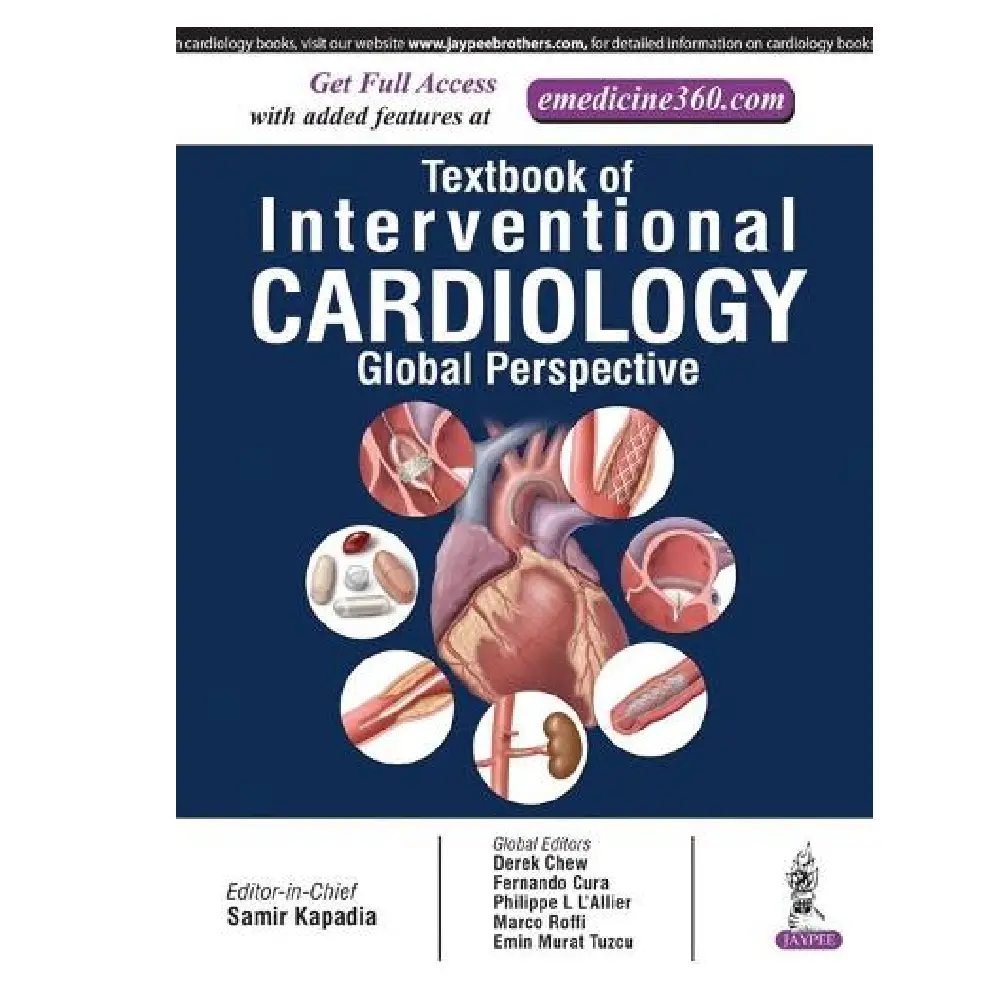
Textbook of Interventional Cardiology: A Global Perspective is an authoritative and expansive clinical resource covering the entire spectrum of interventional cardiology. Edited by internationally recognized experts led by Professor Samir Kapadia, this book is designed to provide practical, evidence-based guidance on interventional techniques and strategies used across the world. It combines global expertise, extensive clinical insights, and detailed procedural knowledge, making it invaluable for cardiologists, fellows, and cardiovascular specialists.
Published in 2017 by Jaypee Brothers Medical Publishers as the first edition, this textbook spans 1,000+ pages (often listed as ~1,584 pages in some editions) and includes more than 700 full-colour images alongside comprehensive text. It is written in English and is a hardbound medical textbook intended for clinicians and learners in cardiovascular medicine.
Foundational Purpose and Structure
The book’s core objective is to present interventional cardiology from a truly global standpoint — integrating diverse clinical practices and procedural philosophies from experts in countries including the USA, Canada, Australia, Switzerland, and Argentina. The underlying premise is that interventional cardiology is not static; it evolves with new technologies, imaging modalities, pharmacologic strategies, and multidisciplinary collaboration.
To facilitate accessibility, the textbook is organized into five principal sections and 88 chapters, each meticulously structured to guide the reader through every aspect of catheter-based interventions. These sections are:
-
Periprocedural Pharmacology and History
-
Coronary Interventions
-
Peripheral Interventions
-
Structural Heart Interventions
-
General Topics and Practice Essentials
This structure allows the reader to navigate from foundational principles through advanced techniques, device tools, imaging applications, and overall practice management strategies in interventional cardiology.
Section I: Periprocedural Pharmacology and Practice Foundations
The first section explores how the field has evolved over decades — from the earliest days of percutaneous coronary intervention (PCI) to the modern emphasis on precision pharmacotherapy. It covers antiplatelet therapies, antithrombotic agents, conscious sedation, contrast agents, and fibrinolytic strategies. This foundation is critical because pharmacology profoundly influences procedural safety, outcome optimization, and patient selection.
Section II: Coronary Interventions
The next major section — and often the most extensive — addresses coronary artery disease (CAD) interventions. This includes both disease-based approaches (e.g., stable angina, primary PCI in STEMI, unstable angina/NSTEMI) and anatomy-based management for challenging lesions such as bifurcations, chronic total occlusions, left main disease, and restenosis.
Detailed analysis of devices — such as drug-eluting stents (DES), balloon technologies, atherectomy tools, intravascular imaging (OCT, IVUS), and functional assessment indices like fractional flow reserve (FFR) — is provided. Patient-specific variations, such as elderly individuals, diabetics, and those with renal dysfunction, are also discussed, emphasizing how interventions must be tailored to individual risk profiles.
Section III: Peripheral and Vascular Interventions
Beyond coronary arteries, interventional cardiology also addresses peripheral vascular disease. This segment includes treatments for aorto-iliac and femoro-popliteal obstruction, below-the-knee angioplasty, carotid artery intervention, renal and visceral artery procedures, and management of dialysis access. Detailed procedural steps, device choices, access techniques, and complication management strategies are thoroughly covered.
Section IV: Structural Heart Interventions
One of the most exciting areas of recent cardiovascular innovation is the treatment of structural heart disease using catheter-based techniques. This section explores transcatheter aortic valve replacement (TAVR), percutaneous mitral valve therapies, pulmonic valve interventions, atrial septal defect and patent foramen ovale closures, and left atrial appendage occlusion, alongside imaging guidance strategies like intracardiac echo and cardiac MRI for procedural planning and execution.
Section V: General Topics and Practice Essentials
The final section emphasizes practical aspects of interventional practice: radiation safety, management of contrast-induced acute kidney injury, bleeding risk mitigation, hemodynamic support, and quality monitoring. This section also stresses teamwork — including multidisciplinary heart team collaboration — and the appropriate use of interventional techniques, outcome reporting, and appraisal of clinical evidence.
Clinical Relevance and Educational Value
The textbook is enriched with clinical case examples that illustrate real-world scenarios, decision-making strategies, and potential complications. These cases help translate theory into practice, making it a useful tool for both training and ongoing clinical reference. Importantly, the online component accompanying the textbook includes videos demonstrating key procedures and imaging studies, further bridging the gap between written guidance and practical execution.
Conclusion
Textbook of Interventional Cardiology: A Global Perspective offers a comprehensive, internationally informed resource that not only teaches procedural skills but also contextualizes the practice within global clinical frameworks. Its emphasis on detailed imaging, pharmacotherapy, devices, and structural innovations ensures that it remains relevant for cardiologists seeking an evidence-based yet practical approach to interventional care.



Reviews
There are no reviews yet