
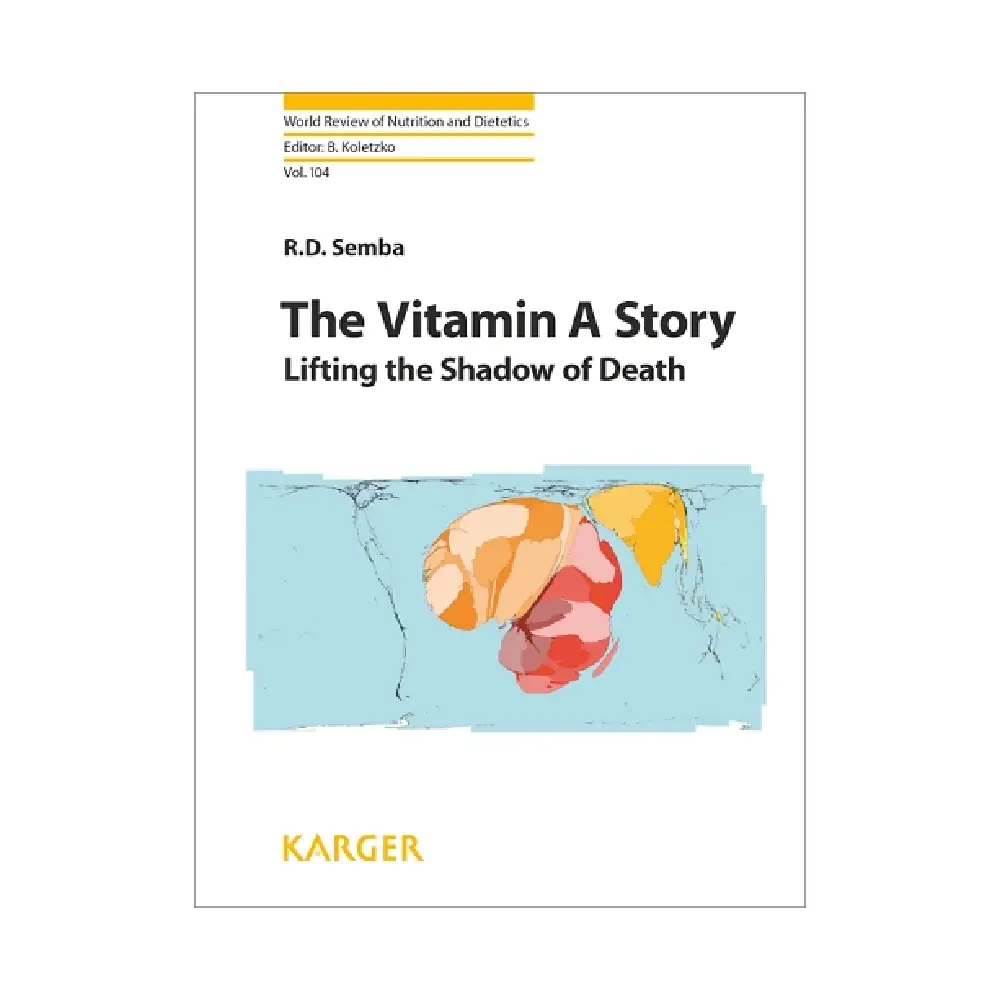


The Vitamin A Story: Lifting the Shadow of Death — Summary
The Vitamin A Story: Lifting the Shadow of Death is a historical and scientific account of vitamin A and its deficiency, written by Richard D. Semba and published in 2012 as Volume 104 of the World Review of Nutrition and Dietetics by S. Karger AG. It blends medical history, public health, science, and culture to explain how vitamin A deficiency (VAD) has affected human health across centuries and how scientific discovery gradually unraveled the mystery of this essential nutrient.
Context and Scope
Long before vitamins were understood, millions of people suffered from night blindness, corneal disease, infection, and death because of diets lacking in what we now know as vitamin A. This deficiency was especially devastating among vulnerable groups — infants, children, sailors, soldiers, and the impoverished. Semba’s book explores not only the biological consequences of VAD but also the social, political, and cultural forces that shaped how the deficiency was viewed (or ignored) over time.
Rather than a traditional science text, the book reads like a historical narrative in which medical mysteries, scientific perseverance, and public health struggles intersect. It is intended for a broad audience — from specialists in nutrition and public health to readers interested in the history of medicine and global health inequities.
Historical Anatomy of Vitamin A Deficiency
Pre-Scientific Observations
The story begins in the 19th century, long before the concept of vitamins existed. Observers on Navy ships, remote colonies, and impoverished regions noted that people developed night blindness and other symptoms under conditions of poor diet. These symptoms were often untreatable and poorly understood, leading observers to speculate on their causes. Historical figures such as François Magendie contributed early descriptions of nutritional disorders, laying the groundwork for later scientific inquiry.
These early episodes often occurred far from academic centers, in places like ship galleys or colonial outposts, where sailors and local inhabitants were exposed to diets lacking in fresh animal products and vegetables — the primary natural sources of vitamin A. The impacts were profound: blindness, increased susceptibility to infections, and high mortality among children were common.
Scientific Discovery and the Concept of Vitamins
A major theme of the book is the “long, rocky road to understanding vitamins.” Throughout the late 19th and early 20th centuries, scientists struggled to isolate and identify the dietary factors that prevented deficiency diseases. It was only with the emerging field of vitamin research that vitamin A was finally identified as essential for vision, growth, and immunity.
Various experiments with milk, butter, cod liver oil, and other foods played a crucial role. Researchers gradually realized that certain fats contained a substance necessary for preventing night blindness and other symptoms. Along the way, misunderstandings about nutrition abounded, and competing scientific theories slowed progress. Semba documents these debates with detailed historical anecdotes, from early laboratory trials to larger human studies.
Cultural and Epidemiological Dimensions
Beyond pure biology, the book highlights how social identity and inequality shaped the experience of vitamin A deficiency. Chapters such as “Free but Not Equal” illustrate how class, geography, and politics determined who suffered most and who had access to better nutrition. Colonial histories reveal stark disparities: indigenous populations in Europe’s former colonies often faced severe deficiency, whereas colonizers typically had access to richer diets.
Semba does not treat VAD merely as a medical problem but as a social injustice — where disparities in food access, economic power, and scientific attention led to preventable suffering. The historical vignettes underscore how deeply nutrition and social structures are intertwined.
Public Health Efforts and Continuing Challenges
Once vitamin A’s biological role was understood, public health efforts turned to prevention and treatment. Supplementation campaigns, dietary diversification, and fortification initiatives have saved countless lives, particularly among children in developing countries. Semba praises these efforts but also critiques their limitations and political bottlenecks. He argues that ideological resistance and lack of historical perspective have, at times, hampered the effective distribution of vitamin A interventions.
The narrative includes accounts of “rescue missions” — organized campaigns to treat at-risk populations and combat deficiency — and discusses the interplay of governments, international agencies, scientists, and local communities in these efforts. Semba’s analysis makes clear that while enormous progress has been made, the shadow of death cast by VAD still lingers where poverty and malnutrition persist.
Scientific and Historical Legacy
One of the book’s key achievements is showing how a single nutrient can illuminate broader themes in science and society. The struggle to understand vitamin A mirrors larger developments in nutrition science, from isolated observations of diseases to sophisticated molecular and epidemiological research. It also highlights how public health depends not only on scientific discovery but on equitable social structures, economic resources, and political will.
Semba’s work is thus both a medical history and a case study in global health equity. It serves as a reminder that while vitamins are a biochemical fact, their distribution and impact are deeply shaped by human institutions.
Conclusion
The Vitamin A Story: Lifting the Shadow of Death is a richly documented, historically grounded exploration of how VAD affected human populations and how science and public health responded. It chronicles the tragic consequences of deficiency, the tenacity of researchers, and the complex interplay of culture, politics, and biology in shaping human health. By weaving together narrative history with scientific insight, the book makes a compelling case for understanding nutrition as both a biological necessity and a social imperative.
Reviews
There are no reviews yet