
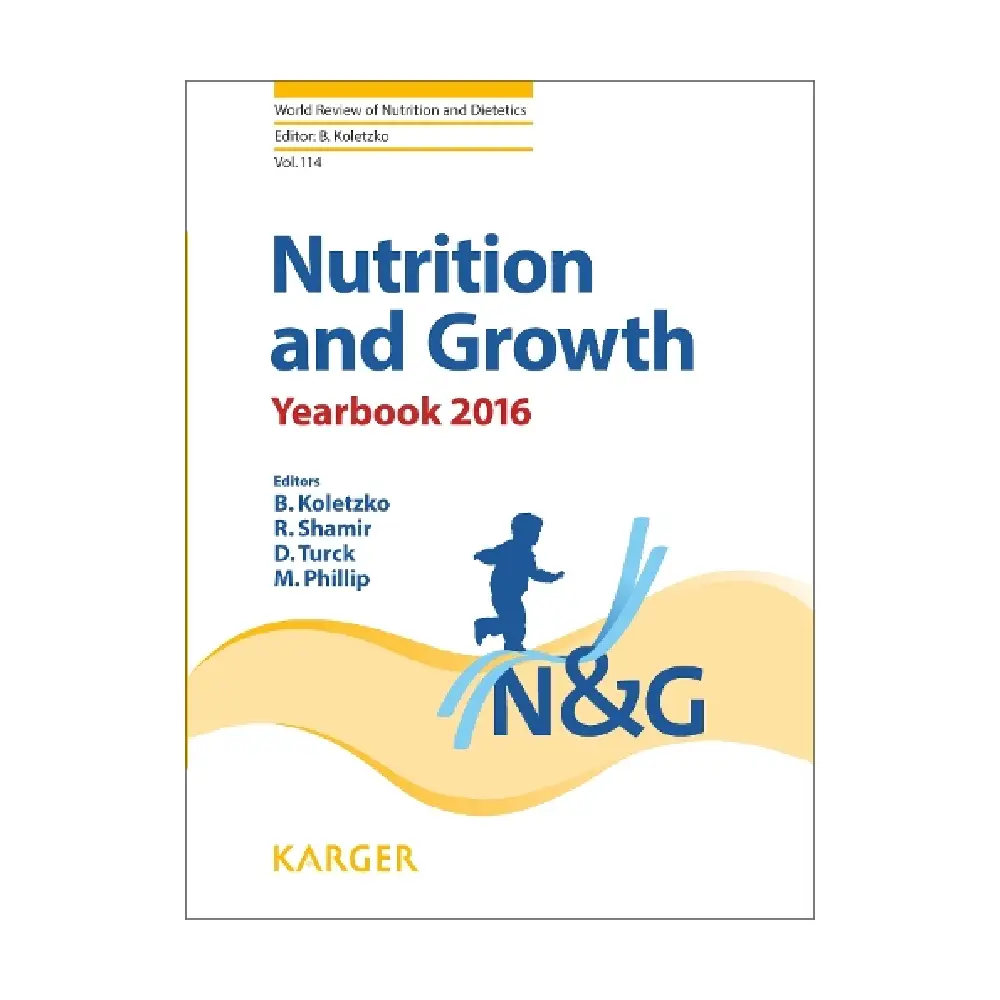


Nutrition and Growth: Yearbook 2016 — Comprehensive Summary
Nutrition and Growth: Yearbook 2016 is Volume 114 in the World Review of Nutrition and Dietetics series, edited by Berthold Koletzko, Raanan Shamir, Dominique Turck, and Moshe Phillip. Published in 2016 by S. Karger AG in Basel, Switzerland, this yearbook provides a curated update on scientific research at the intersection of nutrition and human growth, especially in early life. It compiles key advances published between 2013 and 2015, distilling the most clinically relevant studies into editorial summaries and expert commentary for health professionals.
Child growth – from fetal development through infancy and childhood – is a fundamental marker of health and a critical determinant of long-term outcomes. Growth does not occur in isolation: it reflects complex interactions between nutrient intake, metabolic regulation, hormonal signals, genetics, and environmental factors. While the importance of adequate nutrition for normal growth has long been recognized, the precise mechanisms linking specific nutrients to growth processes remain incompletely understood. This yearbook addresses that gap by highlighting emerging insights and unresolved questions from the recent literature.
Purpose and Approach
Unlike traditional textbooks, the Yearbook does not present original research of its own. Instead, it summarizes important peer-reviewed studies and provides editorial commentary on each article’s clinical significance. The book is structured around selected papers that the editors judged to be among the most impactful in the field during the target period. Each chapter contains:
-
A brief summary of a research article
-
An editor’s interpretation, discussing strengths, limitations, and relevance to clinical practice
-
Contextualization within broader scientific understanding
This format makes the volume highly practical: readers can quickly grasp the essence of important publications, understand how new findings fit into existing knowledge, and consider how to apply them in practice. It is especially useful for professionals who may not have time to read all primary research in depth.
Key Themes and Topics Covered
Though individual chapters span diverse subjects, several major themes recur throughout the yearbook:
1. Physiology and Mechanisms of Growth
A central focus is on understanding biological mechanisms that govern growth. Studies reviewed in the book explore how hormones (such as growth hormone and insulin-like growth factors), nutrient supply, and cellular signaling pathways coordinate to influence linear growth, body composition, and developmental timing. These mechanisms are crucial not just in healthy children but also in disorders of growth such as failure to thrive or short stature.
2. Early Nutrition and Lifelong Outcomes
One important research domain covered is early nutrition – especially the first 1,000 days from conception through the first two years of life. In this period, nutrient exposures have disproportionate effects on growth trajectories, immune function, and metabolic programming. For example, insufficient protein or micronutrients during early infancy can compromise growth, while excessive energy intake may predispose to obesity later in life. A chapter specifically examining how early nutrition influences body composition and later obesity underscores the importance of balanced feeding strategies in infancy.
3. Interplay Between Nutrition and Growth Disorders
The yearbook reviews research on how nutritional factors contribute to growth disorders. This includes conditions like stunting (chronic undernutrition leading to impaired height gain) and catch-up growth after malnutrition. These studies are particularly relevant in low- and middle-income countries where undernutrition remains prevalent. Adequate intake of protein, essential fatty acids, and micronutrients like zinc and iron are shown to be critical for promoting healthy growth and preventing long-term deficits.
4. Nutrition in Specific Clinical Contexts
Beyond general growth patterns, the volume includes articles on:
-
Nutritional needs in chronic disease states
-
Growth implications of preterm and term infant feeding
-
Effects of maternal nutrition on fetal development
-
The role of breastfeeding and early complementary feeding
These topics reflect the book’s commitment to addressing growth from a lifecourse perspective, recognizing that challenges to optimal development can originate prenatally and persist through childhood.
Clinical Relevance and Utility
A major strength of Nutrition and Growth: Yearbook 2016 is its clinical orientation. Pediatricians, endocrinologists, nutritionists, and dieticians will find it helpful because:
-
It highlights the most actionable research, filtering out less relevant studies.
-
Editors provide contextual comments that translate scientific findings into practical insights.
-
It encourages evidence-based practice by summarizing high-quality studies on nutrition interventions and growth outcomes.
For example, clinicians seeking guidance on how specific feeding regimens affect growth in preterm infants or how early nutrition relates to later obesity will find concise, rigorously reviewed summaries to guide decision-making.
Conclusion
In summary, Nutrition and Growth: Yearbook 2016 offers a valuable snapshot of research advancements at the intersection of nutrition and child growth over a defined recent period. By distilling important findings with expert commentary, it serves as an efficient resource for health professionals aiming to integrate cutting-edge evidence into clinical practice. Whether addressing mechanisms of growth, early nutritional influences, or clinical nutrition challenges, the book underscores the critical role of nutrition in shaping growth trajectories and long-term health.



Reviews
There are no reviews yet