
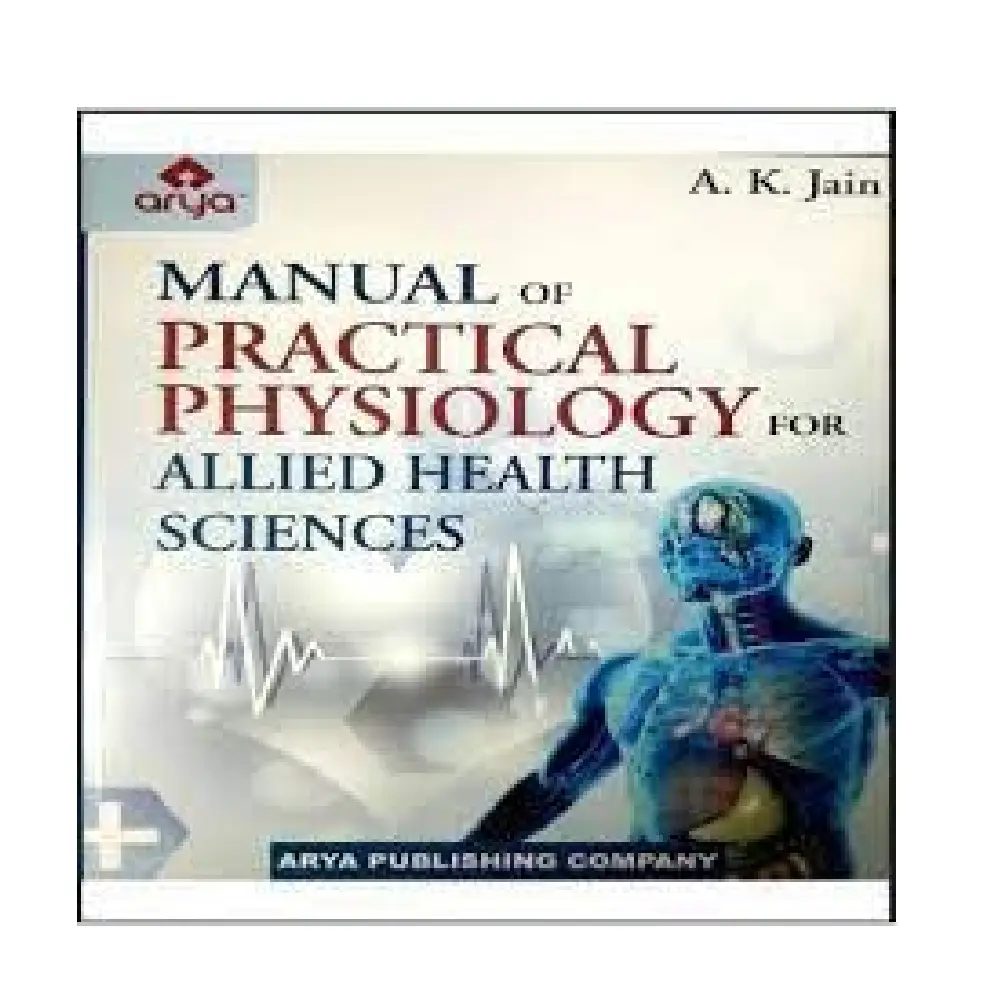
Manual of Practical Physiology for Allied Health Sciences — Overview
The Manual of Practical Physiology for Allied Health Sciences is a comprehensive laboratory manual designed specifically to support allied health students in learning and applying fundamental concepts of human physiology through practical experiments and hands-on exercises. Unlike traditional textbooks that focus primarily on theoretical content, this manual emphasizes experiential learning and skill development, making it an essential companion for laboratory courses in disciplines such as medical laboratory technology, physiotherapy, biomedical sciences, nursing, occupational therapy, and other allied health programs.
Physiology — the study of how the human body functions — forms the backbone of health sciences. To bridge the gap between textbook knowledge and real-life physiological understanding, this manual provides structured laboratory protocols, clear objectives for each experiment, detailed methodologies, data recording formats, and interpretive guidance. Its approach helps students not just memorize facts, but also understand mechanisms, analyze results, and relate physiological phenomena to clinical practice.
Purpose and Educational Importance
The chief purpose of this manual is to equip learners with the practical competencies needed in physiology labs. Allied health curricula often include physiology as a core subject, but many students struggle to translate theoretical knowledge into experimental practice. This manual addresses that challenge by:
-
Presenting step-by-step experimental procedures that are easy to follow.
-
Introducing students to the use of laboratory instruments such as centesimal pipettes, potentiometers, kymographs, spirometers, microscopes, timers, and recording devices.
-
Providing structured observation sheets that aid in accurate and systematic data collection.
-
Encouraging interpretation and analysis of results rather than mere performance of exercises.
-
Reinforcing concepts through questions that test understanding and application.
By contextualizing physiological measurements with clinical relevance, the manual also prepares students for future roles in patient assessment, diagnostic testing, and therapeutic monitoring.
Scope and Content Structure
The manual covers a wide range of practical exercises typically included in a physiology laboratory course. Although different editions may vary slightly in organization, the core topics generally include:
-
Introduction to Physiology Laboratory
-
Safety rules, ethical practices, handling specimens, and proper laboratory conduct.
-
Introduction to scientific measurement and recording.
-
-
Blood and Circulatory Physiology
-
Hemoglobin estimation, red blood cell counting, blood typing.
-
Techniques to analyze clotting time, bleeding time, erythrocyte sedimentation rate.
-
Recording cardiac cycle events, pulse pressure, and blood pressure measurement.
-
-
Muscle Function and Nerve Physiology
-
Recording simple muscle contractions with kymographs.
-
Reflex actions, nerve conduction, motor unit recruitment, and fatigue studies.
-
Demonstrations of stretch reflex and reaction time experiments.
-
-
Respiratory Physiology
-
Spirometric measurements such as tidal volume, vital capacity, and forced expiratory volume.
-
Respiratory rate, minute ventilation, and pulmonary function curves.
-
-
Renal and Excretory Function
-
Tests for urine analysis — physical and chemical properties.
-
Concepts of glomerular filtration and concentrating ability.
-
-
Special Senses
-
Experiments related to vision, hearing, smell, and taste.
-
Interpretation of sensory thresholds and adaptation.
-
-
Endocrine and Metabolic Functions
-
Demonstrations of glucose tolerance tests.
-
Identification of hormones via biological assays.
-
Each experiment begins with stated objectives that explain what the student should learn, followed by materials required, precise procedure, expected observations, and discussion points. Many manuals also include diagrams, photographs, and charts to aid understanding.
Student-Centered Features
A distinguishing feature of this manual is its clarity and learner-friendly layout. It typically offers:
-
Clear procedural steps that reduce ambiguity and error in experiments.
-
Illustrations and diagrams that visually explain setups, graphs, and equipment.
-
Data tables and formats ready for students to record their observations.
-
Result interpretation sections that guide students in analyzing outcomes.
-
Self-assessment questions and discussion prompts that reinforce learning.
These elements together help students develop critical thinking skills, enhance laboratory confidence, and foster scientific inquiry — all of which are key to success in allied health professions.
Relevance to Allied Health Professions
For allied health students, understanding physiology is not just academic — it is foundational to clinical practice. Physiology explains how body systems operate under normal conditions and how deviations manifest in disease. Practical skills in physiological measurement are crucial for tasks such as:
-
Assessing patient vitals and respiratory function.
-
Understanding blood chemistry and hematological parameters.
-
Monitoring neuromuscular function in rehabilitation settings.
-
Conducting screening tests in diagnostic laboratories.
By combining theoretical knowledge with real laboratory experiences, the manual supports the development of professionals who are competent, observant, and clinically informed.
Conclusion
The Manual of Practical Physiology for Allied Health Sciences is a valuable educational resource that bridges theory and practice. Its detailed experimental guidance, structured layout, and emphasis on comprehension equip students with the skills and confidence needed for laboratory work and future clinical responsibilities in allied health fields. Whether used as a primary lab guide or a supplementary study tool, this manual enhances understanding of human physiology and promotes scientific rigor.


Reviews
There are no reviews yet