
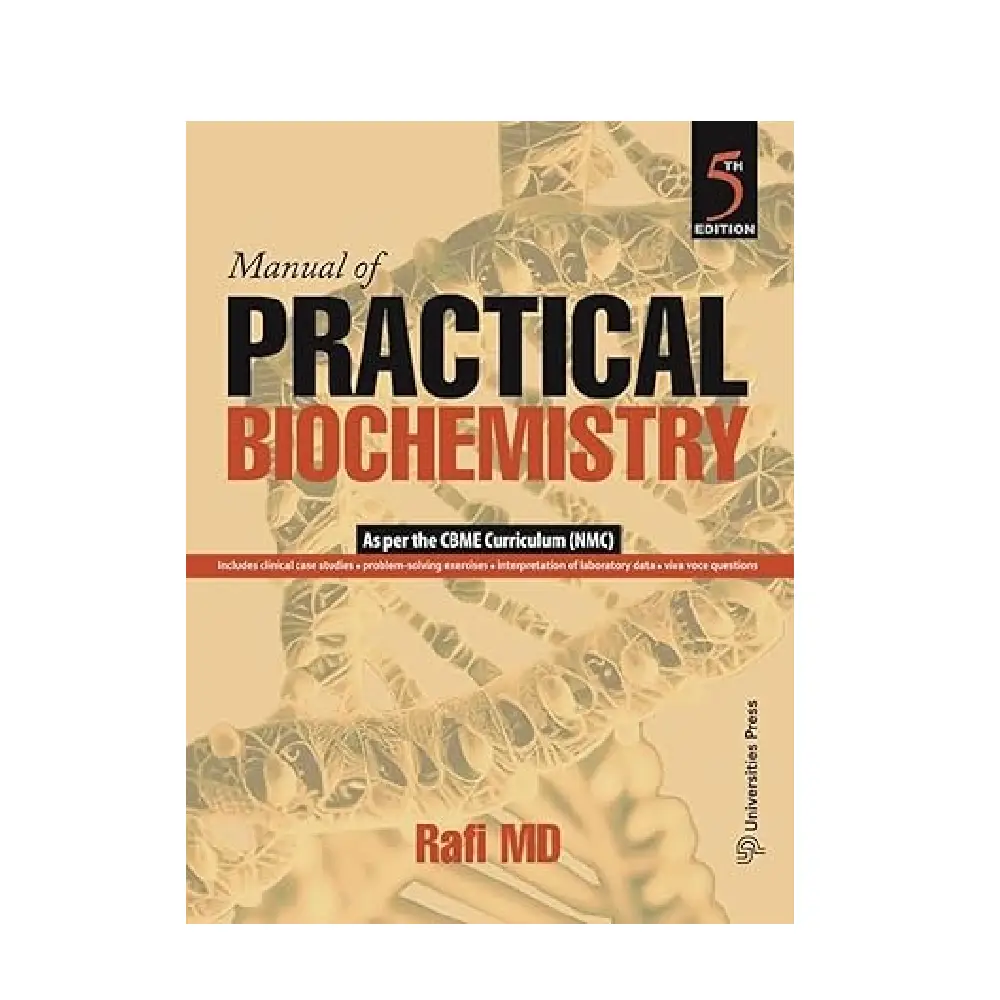
Manual of Practical Biochemistry, 5th Edition — A Comprehensive Guide for Clinical Laboratories and Students
The Manual of Practical Biochemistry (5th Edition) is a cornerstone textbook in the field of biochemistry laboratory training. Designed for undergraduate and postgraduate students in medical, dental, nursing, and allied health sciences, this manual provides a structured, practical, and hands-on approach to the biochemical techniques used in clinical laboratories. Unlike theoretical textbooks that explain biochemical principles in abstract terms, this manual teaches how to perform experiments, interpret data, and apply tests in real clinical scenarios. It bridges the gap between theory and practice — making it essential for students preparing for lab work, viva voce, exams, and professional competence.
1. Purpose and Scope
The primary objective of the Manual of Practical Biochemistry is to equip learners with:
-
Practical skills in laboratory techniques
-
Understanding of clinical correlations between tests and diseases
-
Competence in data analysis
-
Familiarity with laboratory safety and protocols
-
Preparation for laboratory-based examinations
This edition maintains a logical flow from basic laboratory procedures to advanced biochemical assays that are routinely performed in clinical settings. It strikes a balance between simplicity for beginners and enough depth for advanced learners.
2. Organization of Content
The manual is typically organized into the following sections:
A. Laboratory Fundamentals
The early chapters focus on the basics of laboratory work, including:
-
Laboratory safety rules
-
Handling of glassware and instruments
-
Preparation of solutions and reagents
-
Use of pipettes, spectrophotometers, centrifuges, and colorimeters
-
Principles of measurement and calibration
Here, students learn how to prepare buffers, dilutions, standard curves, and calibrate equipment — foundational skills for all biochemical assays.
B. Qualitative Tests
This section deals with qualitative analysis — identifying the presence or absence of key biomolecules, enzymes, and metabolites. Typical tests include:
-
Protein detection tests (e.g., Biuret, Millon’s, Xanthoproteic)
-
Carbohydrate screening (e.g., Benedict’s, Fehling’s)
-
Lipid detection procedures
Each protocol includes step-by-step instructions, expected observations, and common errors to avoid.
C. Quantitative Biochemical Assays
The core of the manual is devoted to quantitative tests — those that measure the concentration of clinically significant analytes. These include:
-
Glucose estimation by biochemical methods
-
Protein quantitation
-
Urea and creatinine assays
-
Lipid profile components (cholesterol, triglycerides, HDL)
-
Enzyme activity measurements (AST, ALT, ALP)
Detailed procedures are provided with tables for standard values, formulae for calculations, and methods to express results in appropriate units.
D. Enzymes and Hormonal Studies
Advanced chapters address enzyme kinetics, diagnostic enzyme assays, and hormonal measurements such as:
-
Thyroid function tests
-
Serum enzyme levels in liver and cardiac diseases
These sections reinforce how laboratory results are interpreted in clinical diagnoses.
E. Quality Control and Clinical Correlation
A critical part of laboratory biochemistry is quality assurance. The manual includes:
-
Internal quality control procedures
-
Reference ranges and biological variation
-
Interpretation of abnormal results and clinical significance
Here, students learn how analytical imprecision or pre-analytical errors can influence outcomes.
3. Teaching Methodology and Pedagogy
A key strength of the Manual of Practical Biochemistry is its learner-friendly pedagogy:
Step-by-Step Protocols
Every experiment is broken down into clear steps, which helps students replicate procedures reliably in the lab.
Illustrations and Tables
Diagrams of apparatus setup, photometric readouts, and tables of normal values help reinforce understanding.
Calculation Examples
Worked examples demonstrate how to derive final test values from raw data — essential for mastering reporting.
Troubleshooting Tips
Each section includes “common pitfalls” and how to troubleshoot them, preparing students for real-world laboratory challenges.
4. Clinical Relevance
What distinguishes this manual from purely academic guides is its emphasis on clinical correlation. Rather than treating biochemical tests as isolated experiments, the manual stresses their diagnostic utility:
-
Elevated AST and ALT in liver disease
-
High glucose and HbA1c in diabetes
-
Lipid profiles in cardiovascular risk assessment
-
Creatinine and urea in renal function evaluation
These links help students understand how laboratory data integrates with clinical decision-making — crucial for careers in medicine, pathology, biochemistry, and biomedical research.
5. Skills Developed
By working through the manual, students develop key competencies:
Technical Skills
Accurate pipetting, solution preparation, spectrophotometric measurements, and reagent handling.
Analytical Thinking
Data interpretation, constructing standard curves, and recognizing aberrant values.
Quality Assurance Practices
Documentation, calibration, internal control, and adherence to protocols.
Professional Laboratory Behaviour
Safety practices, teamwork, ethical handling of specimens, and clear reporting.
6. Importance in Medical Education
In medical, nursing, and allied health curricula, biochemistry practical exams often carry significant weight. Students familiar with this manual:
-
Perform more confidently in viva-voce and practical exams
-
Understand how biochemical tests support diagnoses
-
Are better prepared for clinical rotations involving laboratory investigations
In research settings, the skills learned pave the way for working in diagnostic labs, biotech industries, and research institutions.
7. Challenges and Tips for Students
Managing Precision
Accurate measurements and timing are crucial. Practice with mock setups before real testing.
Understanding Theory
Do not memorize procedures alone — understand the biochemical basis of each test.
Interpreting Variations
Learn how physiological, dietary, and medication factors influence test outcomes.
Conclusion
The Manual of Practical Biochemistry, 5th Edition is more than a procedural guide — it is a bridge between theory and clinical application. With its structured protocols, clinical correlations, and practical insights, it equips students with the confidence to excel in laboratory settings and contributes meaningfully to patient care. Whether you are a medical student, nurse, or biomedical researcher, this manual remains an indispensable resource for mastering the essentials of clinical biochemistry.
Reviews
There are no reviews yet