
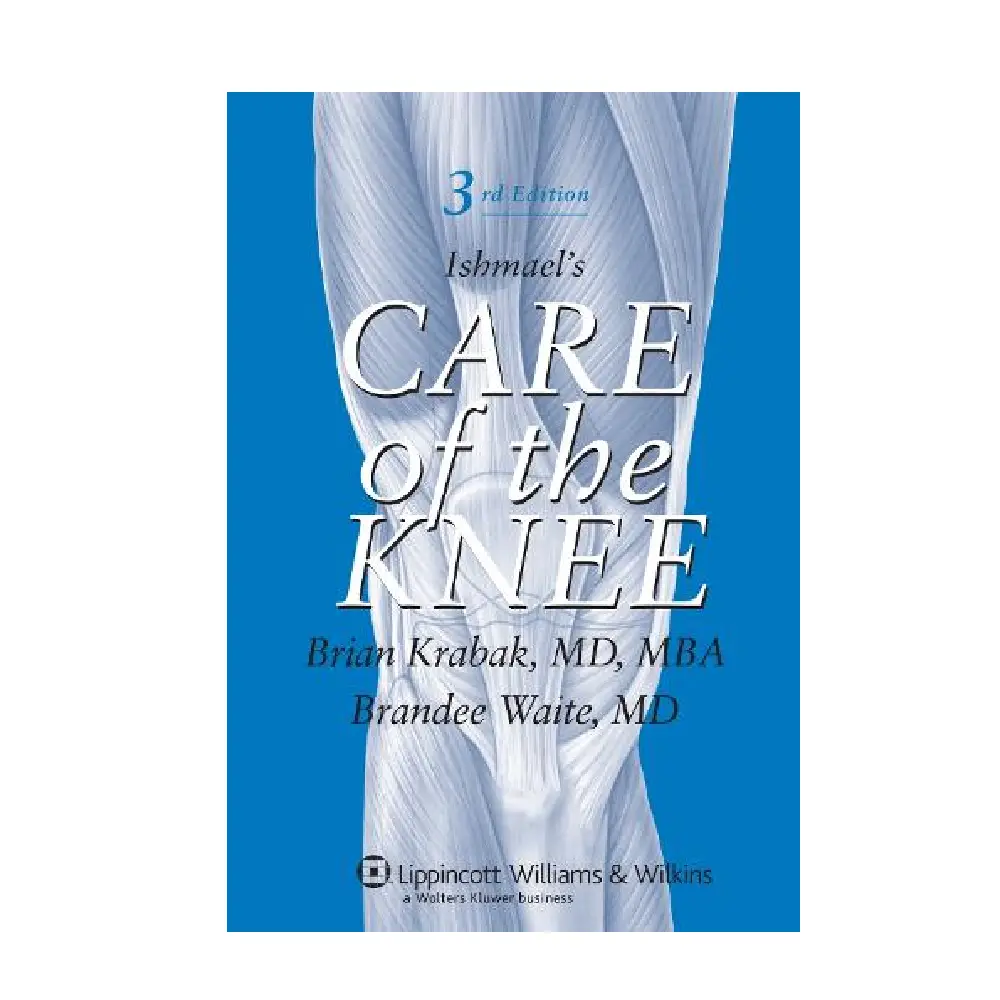

Insall & Scott Surgery of the Knee
(Often informally referred to as “Ishmael’s Care of the Knee,” this landmark work in knee surgery is widely known in orthopedic practice as Insall & Scott Surgery of the Knee.)
Insall & Scott Surgery of the Knee is one of the most authoritative and comprehensive textbooks dedicated to the diagnosis, management, and surgical treatment of knee disorders. For decades, it has served as a foundational reference for orthopedic surgeons, residents, fellows, sports medicine specialists, and physiotherapists worldwide. The book reflects the legacy of Dr. John N. Insall, a pioneer in total knee arthroplasty, and integrates evolving scientific knowledge with practical surgical expertise.
Scope and Importance
The knee joint is one of the most complex and frequently injured joints in the human body. It bears weight, allows mobility, and plays a crucial role in daily activities such as walking, climbing stairs, and athletic performance. Disorders of the knee—ranging from degenerative osteoarthritis to ligament injuries and traumatic fractures—can significantly impair quality of life. This textbook provides a structured and in-depth exploration of these conditions and their management.
The book combines anatomy, biomechanics, pathology, clinical evaluation, imaging, and surgical techniques into a cohesive framework. Its multidisciplinary approach ensures that readers not only understand how to perform procedures but also why certain techniques are preferred based on scientific evidence and patient factors.
Anatomy and Biomechanics
The opening sections offer a detailed review of knee anatomy, including bone structures (femur, tibia, patella), ligaments (ACL, PCL, MCL, LCL), menisci, cartilage, synovium, and surrounding musculature. High-quality illustrations and imaging studies support understanding of normal and pathological anatomy.
Biomechanics is emphasized throughout, highlighting how alignment, load distribution, and joint kinematics influence both injury patterns and long-term outcomes. Understanding these principles is essential for planning surgical corrections and prosthetic designs.
Clinical Evaluation and Imaging
Accurate diagnosis begins with systematic clinical assessment. The book outlines methods for history-taking, physical examination, and interpretation of special tests for ligament instability and meniscal injury. It integrates modern imaging techniques—such as MRI, CT scans, and weight-bearing radiographs—to guide diagnosis and treatment planning.
Clinical algorithms are provided to help practitioners make evidence-based decisions regarding conservative versus surgical management.
Sports Injuries and Ligament Reconstruction
One of the most widely referenced sections deals with sports-related injuries, particularly anterior cruciate ligament (ACL) tears. Detailed chapters describe surgical reconstruction techniques, graft selection, fixation methods, and rehabilitation protocols. The text compares outcomes of different approaches and discusses complication management.
Meniscal preservation strategies are also emphasized, reflecting the modern understanding of the meniscus as a critical structure in joint preservation rather than a dispensable tissue.
Total Knee Arthroplasty (TKA)
A hallmark of this textbook is its comprehensive coverage of total knee replacement surgery. It details:
-
Indications and patient selection
-
Implant design evolution
-
Surgical approaches and alignment techniques
-
Balancing soft tissues
-
Postoperative care and rehabilitation
Revision knee arthroplasty, one of the most technically demanding procedures in orthopedics, is also thoroughly covered. The book provides strategies for managing bone loss, infection, instability, and implant failure.
Pediatric and Adolescent Knee Disorders
The text includes chapters on congenital deformities, growth plate injuries, and pediatric ligamentous injuries. It addresses how treatment approaches differ in skeletally immature patients and emphasizes long-term growth considerations.
Complications and Rehabilitation
No surgical text is complete without addressing complications. The book provides detailed discussions on infection, thromboembolism, stiffness, implant loosening, and periprosthetic fractures. Evidence-based prevention strategies are included.
Rehabilitation principles are integrated into each surgical section, recognizing that optimal outcomes depend on coordinated postoperative care. Physiotherapy protocols, weight-bearing guidelines, and return-to-sport criteria are clearly outlined.
Evidence-Based and Research-Oriented
Modern editions incorporate evidence-based practice, clinical trials, and outcome studies. References to current literature enable readers to explore further research and stay updated with evolving surgical standards.
The book also discusses innovations such as minimally invasive surgery, computer-assisted navigation, patient-specific instrumentation, and robotic-assisted knee arthroplasty.
Educational Value
The text is structured for both learning and reference. Residents benefit from its foundational explanations, while experienced surgeons use it as a technical manual and decision-making guide. The integration of diagrams, operative photographs, and step-by-step surgical descriptions enhances its practical utility.
Conclusion
Insall & Scott Surgery of the Knee remains a gold standard in orthopedic literature. Its depth, clarity, and clinical relevance make it indispensable for professionals involved in knee care. By combining anatomical precision, surgical expertise, and evidence-based guidance, the book continues to shape modern knee surgery practice and education worldwide.
If you would like, I can also provide product details (author, edition, publisher, ISBN, print length, etc.) for the latest edition.




Reviews
There are no reviews yet