
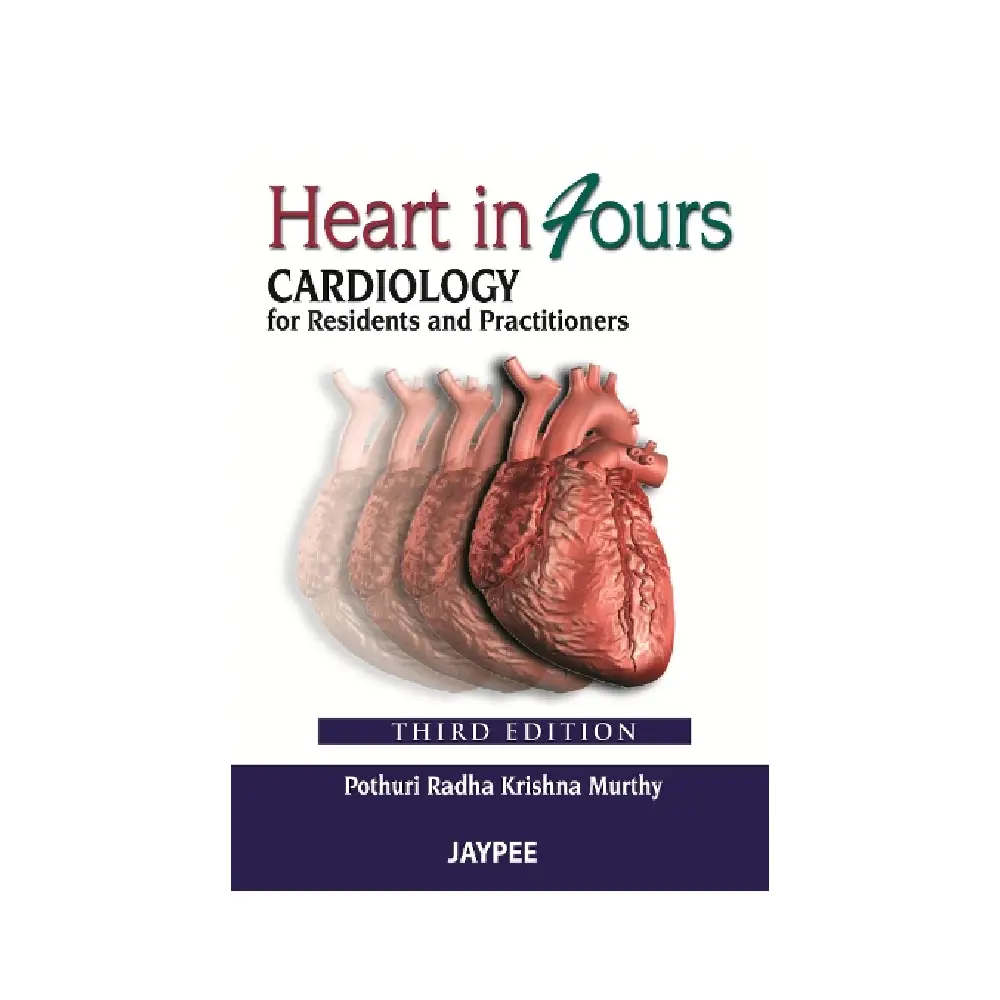
Heart in Fours: Cardiology for Residents and Practitioners
Heart in Fours is a unique, widely used cardiology reference authored by Pothuri Radha Krishna Murthy and published by Jaypee Brothers Medical Publishers (P) Ltd. The book’s third edition was released in 2013 and remains a popular resource among medical students, internal medicine residents, cardiology fellows, and general practitioners seeking a concise yet clinically relevant review of cardiovascular diseases.
This manual adopts an innovative “four-point” approach — presenting each topic with four essential, high-yield clinical facts that encapsulate causes, diagnosis, management, and preventive strategies. This systematic framework simplifies complex cardiology concepts into digestible, memorable segments, making it particularly effective for revision, clinical decision-making, and exam preparation.
Structure and Content
Spanning around 806 pages, Heart in Fours covers the entire spectrum of cardiovascular medicine. Its content integrates foundational pathophysiology with practical clinical insights, blending theoretical knowledge with real-world applicability. Topics are organized to reflect both the common and critical conditions encountered in everyday practice.
The book begins with basic principles of heart function in health and disease, laying the groundwork for understanding the mechanisms that underlie cardiac disorders. It then proceeds through core clinical topics including:
-
Hypertension: Etiology, risk stratification, diagnostic criteria, and management strategies.
-
Heart Failure: Pathogenesis, classification, diagnostic modalities, and therapeutic options.
-
Arrhythmias: Identification of rhythm disorders such as atrial fibrillation and ventricular arrhythmias, diagnostic tools like ECG, and approaches to management.
-
Coronary Artery Disease: Ischemic heart disease, stable and acute coronary syndromes, and intervention-based treatments.
-
Acute Myocardial Infarction and Cardiac Arrest: Emergency recognition, immediate management, and post-event care.
-
Valvular Heart Diseases and Rheumatic Fever: Clinical features, diagnostic pathways, and timing for surgical or medical intervention.
-
Infective Endocarditis: Risk factors, microbiology, diagnosis, and antibiotic therapy.
-
Cardiomyopathies and Myocarditis: Differentiation among various forms, clinical presentations, and therapeutic considerations.
-
Congenital Heart Diseases: Common congenital anomalies, diagnostic strategies, and long-term follow-up.
-
Pulmonary Hypertension and Pulmonary Embolism: Pathophysiology, clinical evaluation, and acute versus chronic management.
-
Non-invasive and Invasive Diagnostics: Including roentgenology, echocardiography, cardiac catheterization, and angiography.
-
Interventional and Surgical Approaches: Indications for PCI, CABG, device therapy, and other procedural interventions.
-
Special Topics: Cardiovascular issues in pregnancy and other miscellaneous subjects relevant to holistic cardiac care.
Educational Approach and Utility
The hallmark of Heart in Fours is its practical and clinically translatable format. Each chapter distills essential information into discrete fours — such as four causes, four clinical features, four diagnostic tools, and four management principles. This structure reinforces rapid recall and practical applicability, which is especially beneficial for those preparing for postgraduate exams such as MD, DNB, and DM cardiology, as well as for clinicians who need quick clinical references.
Newer editions of the book include a dedicated chapter on pregnancy and cardiovascular disease, reflecting the growing importance of cardio-obstetrics — a field that requires specialized knowledge due to the unique physiological changes and risk profiles in pregnant patients.
Numerous clinical photographs, diagrams, and tables further support visual learning. These illustrations help in understanding complex concepts such as heart anatomy, hemodynamic changes, ECG interpretation, and imaging findings. Such visual aids make the text useful not only for examination preparation but also for clinical application in ward and outpatient settings.
Strengths and Limitations
Strengths:
-
Structured for Rapid Learning: The “fours” format supports memory retention and quick clinical review.
-
Broad Clinical Scope: Covers a wide array of cardiovascular conditions from basic to advanced.
-
Practical Orientation: Focuses on clinical application over deep theoretical discussion, which is useful for residents and practicing clinicians.
-
Updated Content: The third edition integrates newer clinical topics and diagnostic advancements relevant to contemporary practice.
Limitations:
-
Not a Comprehensive Textbook: It emphasizes high-yield points rather than in-depth pathophysiology or extensive evidence review.
-
Updates Needed: Since the latest edition dates from 2013, some guideline-based treatment recommendations may not reflect the newest evidence or guideline changes in cardiology.
Conclusion
Heart in Fours: Cardiology for Residents and Practitioners remains a valuable cardiology resource that blends clinical depth with accessibility. Its unique educational format — boiling down complex cardiovascular subjects into four key elements — supports efficient learning, practical recall, and everyday clinical use. The book is especially suited for medical residents, fellows, and practitioners seeking a concise, exam-oriented cardiology guide that bridges foundational knowledge with clinical application.




Reviews
There are no reviews yet