
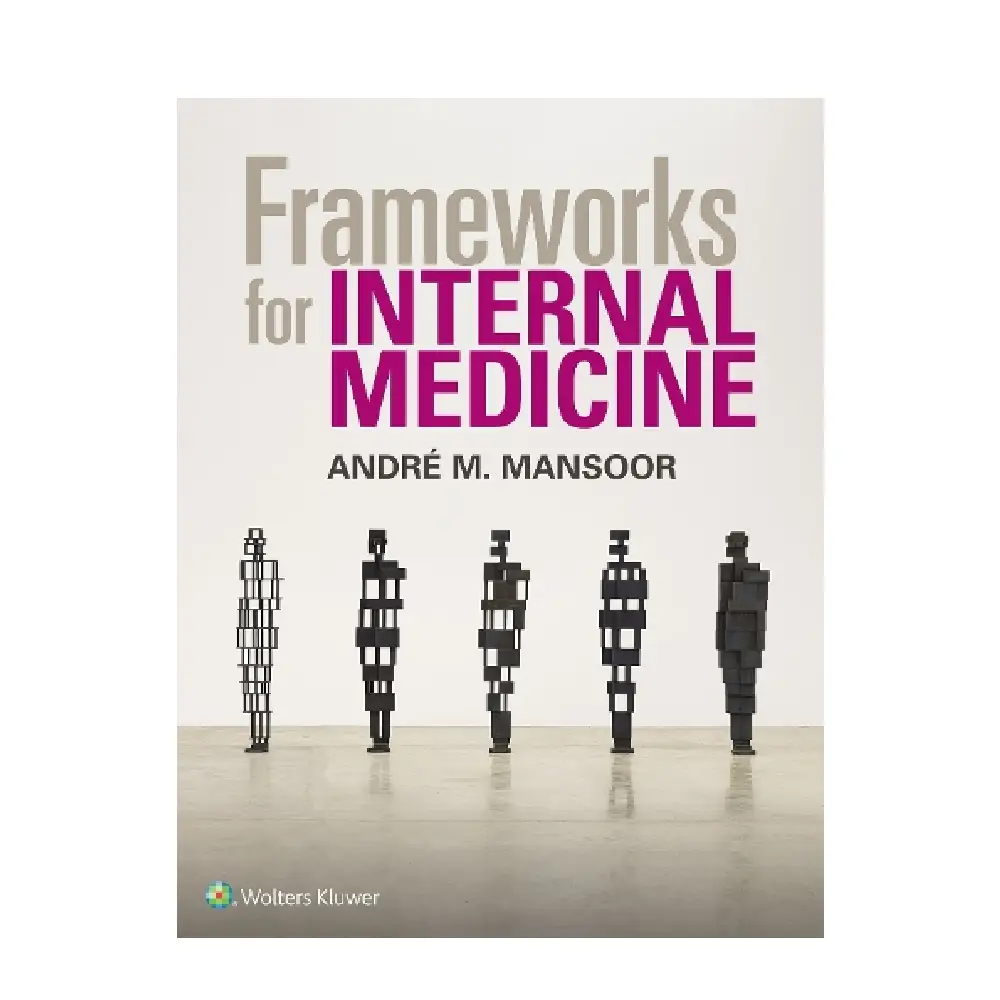
Frameworks for Internal Medicine
Frameworks for Internal Medicine is a practical and structured clinical guide designed to help medical students, interns, and residents develop strong diagnostic reasoning skills in internal medicine. Unlike traditional textbooks that focus primarily on detailed pathophysiology, this book emphasizes organized thinking patterns—“frameworks”—that clinicians can apply at the bedside. By presenting information in algorithmic and systematic formats, it simplifies complex medical problems into manageable clinical approaches.
The book is authored by Andre Mansoor, an experienced internal medicine physician and educator known for his teaching-focused style. His aim in writing Frameworks for Internal Medicine was to provide learners with a resource that bridges the gap between theoretical knowledge and real-world patient care. The book is widely appreciated for its clarity, structured presentation, and clinical relevance.
Core Concept and Structure
The central idea of Frameworks for Internal Medicine is the use of structured clinical frameworks to approach common presenting complaints, laboratory abnormalities, and disease categories. Instead of memorizing long lists of causes, the reader is taught how to think in patterns. For example, when approaching anemia, the book categorizes it based on mean corpuscular volume (MCV)—microcytic, normocytic, or macrocytic—before delving into specific etiologies. This systematic approach enhances retention and diagnostic efficiency.
Each chapter typically begins with a clinical problem—such as chest pain, shortness of breath, or altered mental status—and then outlines a clear diagnostic framework. These frameworks often include:
-
Differential diagnosis organized by pathophysiology
-
Key history questions
-
Important physical examination findings
-
Relevant laboratory and imaging studies
-
Initial management principles
The logical flow of information allows learners to quickly review essential points, making the book particularly useful for ward rounds, examinations, and quick clinical reference.
Clinical Applications
One of the major strengths of Frameworks for Internal Medicine is its focus on practical clinical application. For instance, in the evaluation of chest pain, the framework prioritizes life-threatening conditions such as myocardial infarction, pulmonary embolism, and aortic dissection before considering less urgent causes like musculoskeletal pain or gastroesophageal reflux disease. This prioritization mirrors real-world emergency assessment and promotes patient safety.
Similarly, the book provides structured approaches to electrolyte imbalances, acid–base disorders, fever of unknown origin, syncope, and renal failure. These are common scenarios encountered in internal medicine training, and the framework-based method improves both speed and accuracy in clinical reasoning.
Educational Value
Medical students preparing for clinical rotations and postgraduate entrance exams benefit greatly from this resource. The concise yet comprehensive explanations allow for rapid revision. Residents find it particularly helpful for organizing case presentations and preparing for oral examinations. The book also aligns well with modern competency-based medical education, where structured thinking and problem-solving skills are emphasized.
Another important feature is the clarity of language. Complex concepts are broken down into digestible segments, and unnecessary detail is avoided. The book avoids overwhelming readers with excessive pathophysiological minutiae while still maintaining scientific accuracy.
Strengths
-
Structured Diagnostic Thinking: Promotes logical clinical reasoning.
-
Concise Presentation: High-yield information without excessive detail.
-
Practical Focus: Directly applicable to bedside medicine.
-
Exam-Oriented: Useful for medical school and residency exams.
-
Comprehensive Coverage: Includes cardiology, pulmonology, nephrology, endocrinology, hematology, infectious diseases, and more.
Limitations
While the book excels as a framework-based guide, it is not a replacement for comprehensive reference textbooks like Harrison’s Principles of Internal Medicine. Instead, it serves as a complementary resource. Readers seeking in-depth pathophysiological explanations or extensive research discussions may need to consult larger textbooks.
Additionally, because of its concise nature, some rare conditions receive limited coverage. However, this limitation aligns with the book’s goal of focusing on high-yield and commonly encountered clinical problems.
Conclusion
Frameworks for Internal Medicine by Andre Mansoor is a highly practical and learner-friendly resource that emphasizes structured clinical reasoning. Its framework-based approach transforms complex medical topics into organized diagnostic pathways, making it particularly valuable for medical students, interns, and residents. By prioritizing clarity, logic, and bedside applicability, the book helps bridge the gap between classroom knowledge and real-world clinical practice.




Reviews
There are no reviews yet