
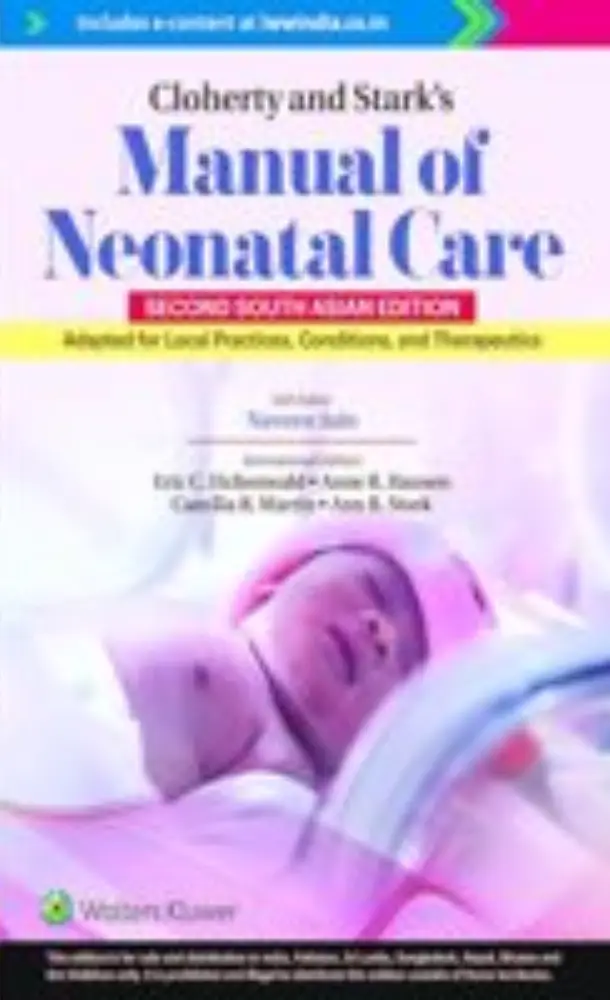
Cloherty and Stark’s Manual of Neonatal Care
Cloherty and Stark’s Manual of Neonatal Care, 2nd Edition, South Asian Edition is a highly regarded clinical reference designed to guide healthcare professionals in the management of newborns, particularly those requiring intensive care. Adapted from the internationally acclaimed original text, this South Asian edition tailors content to regional needs, resource settings, and disease patterns, making it especially relevant for practitioners in countries like India, Pakistan, Bangladesh, and neighboring regions.
The book provides a comprehensive overview of neonatal medicine, beginning with foundational principles such as fetal development, transition to extrauterine life, and the physiological adaptations that occur immediately after birth. It emphasizes the importance of understanding normal neonatal physiology to effectively recognize and manage abnormalities. This foundational knowledge is essential for both routine newborn care and the early identification of high-risk infants.
A major strength of the manual is its systematic approach to neonatal assessment and resuscitation. It incorporates evidence-based guidelines for the immediate care of newborns in the delivery room, including airway management, thermal regulation, and initial stabilization. The text aligns closely with internationally accepted neonatal resuscitation protocols, while also considering practical challenges faced in resource-limited settings. Clear algorithms and step-by-step instructions make it a valuable tool for clinicians working in emergency situations.
The book extensively covers common neonatal conditions, including respiratory distress syndrome, neonatal sepsis, jaundice, hypoglycemia, and birth asphyxia. Each condition is discussed in terms of etiology, clinical presentation, diagnosis, and management. Special attention is given to infections, which remain a major cause of neonatal morbidity and mortality in South Asia. The authors highlight early recognition, appropriate use of antibiotics, and preventive strategies such as aseptic techniques and maternal screening.
Prematurity and low birth weight are key focus areas, reflecting their high prevalence in the region. The manual provides detailed guidance on the care of preterm infants, including nutritional support, thermoregulation, and prevention of complications such as necrotizing enterocolitis and intraventricular hemorrhage. It also discusses developmental care practices, such as kangaroo mother care, which are particularly beneficial in low-resource environments.
Another important aspect of the book is its coverage of neonatal nutrition. Breastfeeding is strongly promoted as the optimal source of nutrition, and the text provides practical advice on lactation support, feeding techniques, and management of feeding difficulties. For infants who cannot be breastfed, alternative feeding strategies, including parenteral nutrition, are discussed in detail.
The manual also addresses a wide range of specialized topics, including congenital anomalies, metabolic disorders, and neurological conditions. It provides guidance on diagnostic investigations, such as laboratory tests and imaging, and emphasizes the importance of early intervention to improve outcomes. Ethical considerations, including decision-making in critically ill neonates, are also explored, reflecting the complex nature of neonatal care.
The South Asian edition distinguishes itself by incorporating region-specific data, treatment protocols, and public health perspectives. It acknowledges challenges such as limited access to advanced technology, variability in healthcare infrastructure, and socioeconomic factors that influence neonatal outcomes. The book offers practical solutions and adaptable strategies to deliver effective care in diverse clinical settings.
Designed for ease of use, the manual features concise chapters, bullet points, tables, and clinical algorithms that facilitate quick reference in busy clinical environments. It is suitable for a wide range of healthcare providers, including neonatologists, pediatricians, residents, nurses, and medical students.
In conclusion, Cloherty and Stark’s Manual of Neonatal Care, 2nd Edition, South Asian Edition is an indispensable resource for neonatal healthcare. Its blend of evidence-based medicine, practical guidance, and regional relevance makes it an essential tool for improving the quality of newborn care. By addressing both common and complex neonatal conditions, the book supports clinicians in delivering timely, effective, and compassionate care to vulnerable newborns.

Reviews
There are no reviews yet