
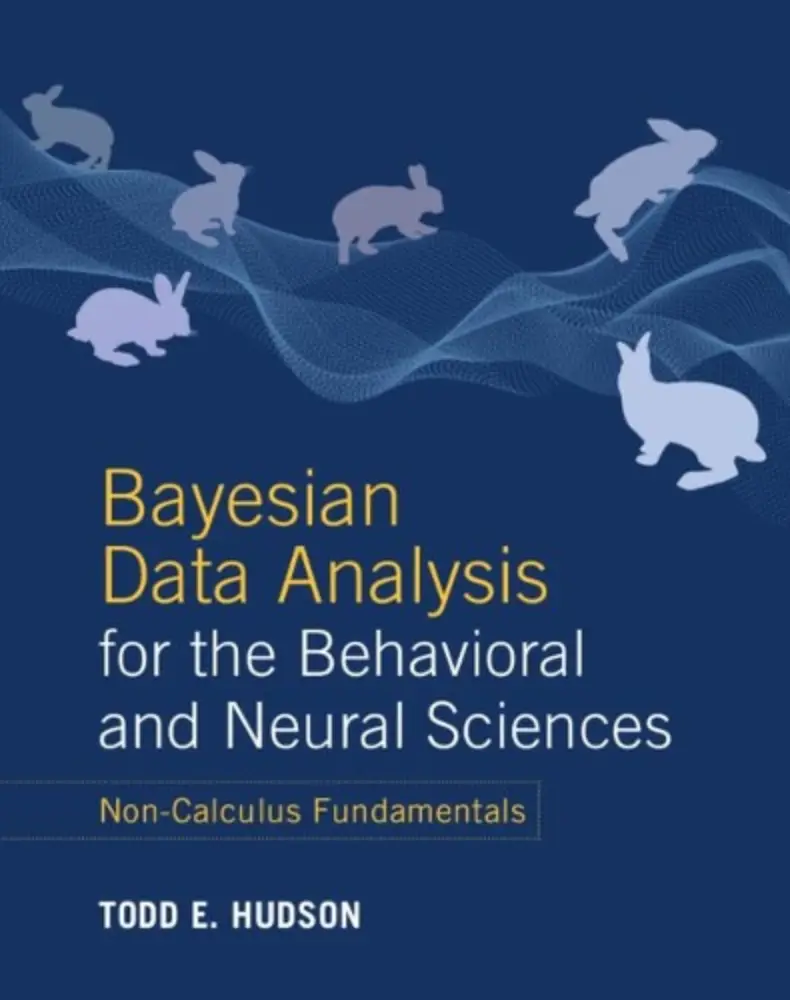

Bayesian Data Analysis for the Behavioral and Neural Sciences
Bayesian Data Analysis for the Behavioral and Neural Sciences is a comprehensive guide that introduces researchers, students, and practitioners in psychology, neuroscience, and behavioral sciences to the principles and applications of Bayesian statistical methods. In contrast to traditional frequentist approaches, Bayesian statistics provide a flexible and intuitive framework for analyzing data by incorporating prior knowledge and updating beliefs in light of new evidence. This approach is particularly valuable in the behavioral and neural sciences, where data are often complex, multidimensional, and collected under conditions of uncertainty.
The book begins with a thorough introduction to the foundational concepts of Bayesian statistics. Readers are guided through the philosophical underpinnings of the Bayesian approach, including the interpretation of probability as a degree of belief rather than a long-run frequency. The text explains Bayes’ theorem in a step-by-step manner, emphasizing how prior information can be combined with observed data to form posterior distributions that represent updated knowledge. This conceptual foundation is critical for understanding how Bayesian methods differ from classical statistical inference and why they are particularly suited for complex behavioral and neural datasets.
A core strength of the book is its focus on practical application. The authors provide numerous examples drawn from behavioral experiments, cognitive neuroscience studies, and neuroimaging research. These examples illustrate how Bayesian methods can be applied to a wide range of analyses, including estimating means and variances, modeling relationships between variables, testing hypotheses, and making predictions. Special attention is given to hierarchical modeling, which allows for the analysis of data with nested structures, such as repeated measures from multiple participants or multi-level brain imaging data. By modeling both within-subject and between-subject variability, Bayesian hierarchical models offer more precise estimates and better generalization than traditional methods.
The text also emphasizes computational approaches, equipping readers with the tools needed to implement Bayesian analyses using modern software. Techniques such as Markov Chain Monte Carlo (MCMC) methods, Gibbs sampling, and Hamiltonian Monte Carlo are explained in accessible terms, and practical guidance is provided for using software packages like R, Stan, and Python libraries. These computational tools enable researchers to fit complex models, visualize posterior distributions, and conduct model checking and comparison.
Another important feature of the book is its discussion of model evaluation and criticism. Bayesian analysis is not just about fitting models; it is also about assessing model adequacy, identifying assumptions, and comparing alternative models. The authors introduce methods such as posterior predictive checks, Bayes factors, and information criteria to evaluate model performance, helping researchers ensure that their conclusions are robust and well-supported by the data.
The book balances theory and application, making it suitable for readers with a range of backgrounds. While it provides the necessary mathematical foundations, the explanations are clear, examples are practical, and the step-by-step procedures encourage active learning. Visualizations of posterior distributions, credible intervals, and predictive checks further enhance understanding and help readers interpret results in context.
Ethical and methodological considerations are also addressed, including transparency in model specification, reproducibility of analyses, and the responsible use of prior information. These topics are crucial in behavioral and neural sciences, where misinterpretation of data or overconfidence in conclusions can have significant implications.
In conclusion, Bayesian Data Analysis for the Behavioral and Neural Sciences is an essential resource for anyone seeking to apply Bayesian methods in research. Its comprehensive coverage of theory, practical examples, computational techniques, and model evaluation makes it an invaluable guide for students, researchers, and professionals aiming to analyze behavioral and neural data rigorously. By integrating statistical reasoning with real-world applications, the book empowers readers to make more informed, flexible, and interpretable inferences from complex datasets, advancing both scientific understanding and methodological rigor in the field.







Reviews
There are no reviews yet