
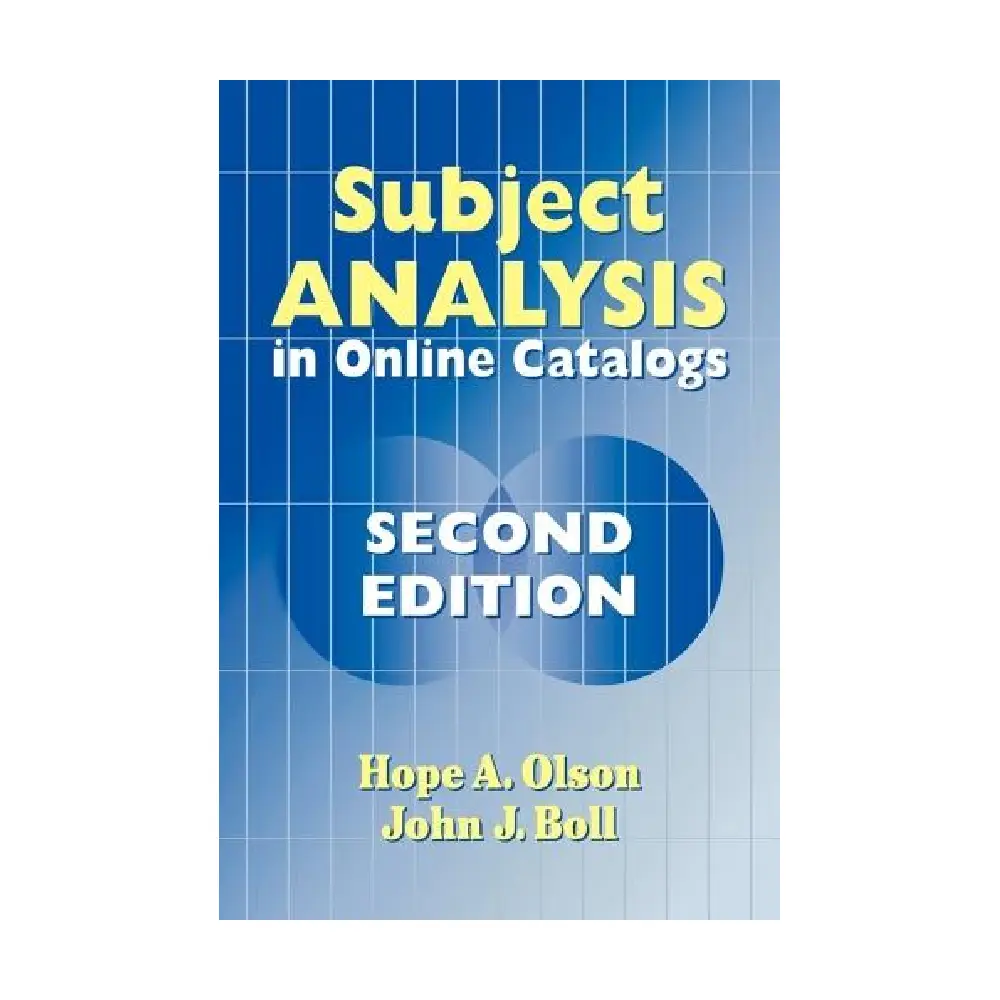


Subject Analysis in Online Catalogs, 2nd Edition is a foundational text for understanding how subjects are analyzed, represented, and retrieved in modern online library catalogs and discovery systems. Written for catalogers, metadata specialists, and information professionals, this edition builds on previous work by integrating contemporary principles of subject analysis with the realities of digital environments, linked data, and user-centered retrieval.
At its core, the book explores how libraries and information systems organize knowledge so that users can effectively find what they need. Traditional cataloging focused on descriptive metadata—titles, authors, publication details—but as collections migrated online and diversified, subject access became increasingly complex. Subject analysis determines how the intellectual content of a work is represented in a catalog, usually through controlled vocabularies, classification systems, and indexing practices. Accurate subject analysis enhances discovery, supports precise searching, and connects users with relevant materials even when their search terms differ from how content was originally described.
The second edition begins with a historical overview of subject analysis, tracing its evolution from early card catalogs to modern online public access catalogs (OPACs) and discovery layers. This historical context is crucial because it illustrates how changing user expectations and technological capabilities have shaped cataloging practices. While early systems assumed users would browse or know precise terminology, digital catalogs now anticipate varied queries and support natural language searching. As such, subject analysis must balance machine-readable structure with human semantics.
One of the book’s central themes is the use of controlled vocabularies—standardized sets of terms that ensure consistency in how subjects are represented. The editors explain the rationale behind authority control and subject headings, such as those found in the Library of Congress Subject Headings (LCSH) or Medical Subject Headings (MeSH). Controlled vocabularies enable catalogs to group related works and reconcile synonyms or variant forms. For instance, terms like “automobiles,” “cars,” and “motor vehicles” can be linked so users find all relevant materials regardless of their initial query. The book compares different vocabularies, highlighting strengths and limitations, and offers guidance on selecting or adapting vocabularies for particular collections.
Classification systems are also covered extensively. Systems like the Dewey Decimal Classification (DDC) and the Library of Congress Classification (LCC) organize knowledge into hierarchical structures. These systems place materials within broader conceptual frameworks, supporting both browsing and precision retrieval. The text discusses how subjects are selected, how classification numbers are constructed, and how notation systems influence user navigation. It also addresses interdisciplinary works that challenge rigid classification and require nuanced decisions by catalogers.
Indexing and metadata standards are explored in depth. Metadata schemas such as Dublin Core, MARC (Machine-Readable Cataloging), and emerging formats for linked data provide structures for encoding subject information. The book explains how subject elements are defined within these schemas and how they interact with other descriptive elements. Importantly, it highlights the shift toward linked data and semantic web technologies, where subject descriptors are not just text strings but interconnected entities. Linked data allows subject terms to be linked across platforms, enriching discovery through relationships and external knowledge graphs.
User behavior and information retrieval theory provide another critical layer of analysis. The authors emphasize that subject analysis must reflect how real users search. Studies of search behavior reveal that users often deploy natural language queries, incomplete phrases, or general concepts rather than precise subject headings. Therefore, catalogs must balance controlled vocabularies with search-engine features like term expansion, synonyms, and relevance ranking. The book addresses algorithmic retrieval, facets, and filters, and how subject metadata feeds into these systems. It also discusses evaluation metrics for search effectiveness and strategies for aligning catalog design with user needs.
Ethical and cultural considerations are woven throughout. Subject analysis is not neutral; the selection of terms, classifications, and vocabularies can reflect cultural biases or systemic limitations. The book encourages critical reflection on inclusive practices, culturally responsive metadata, and the representation of marginalized knowledge systems. Case studies illustrate how traditional vocabularies may inadequately represent indigenous, gender, or global perspectives and offer approaches to developing supplemental vocabularies that honor diverse expressions of knowledge.
Practical workflows and tools are a significant component of the text. The authors provide step-by-step guides for conducting subject analysis, creating authority records, and implementing controlled vocabularies within catalog systems. Screenshots and examples from real catalog interfaces help ground theoretical concepts. There are also discussions of quality control, including auditing subject headings for consistency and assessing user feedback to refine subject access points.
The second edition reflects contemporary challenges such as managing large digital collections, integrating external datasets, and supporting discovery across multiple platforms. It acknowledges that modern catalogs are not isolated systems but part of broader ecosystems that include institutional repositories, aggregators, and search engines like Google Scholar. As a result, subject metadata must be interoperable and optimized for external visibility.
Overall, Subject Analysis in Online Catalogs, 2nd Edition is both a theoretical and practical reference. It equips information professionals with a deep understanding of how subject representation influences discovery, structures retrieval systems, and impacts user experience. Its comprehensive coverage—spanning controlled vocabularies, classification, metadata standards, user behavior, and ethical considerations—makes it an essential guide for anyone involved in organizing or improving access to knowledge in the digital age.
Reviews
There are no reviews yet