
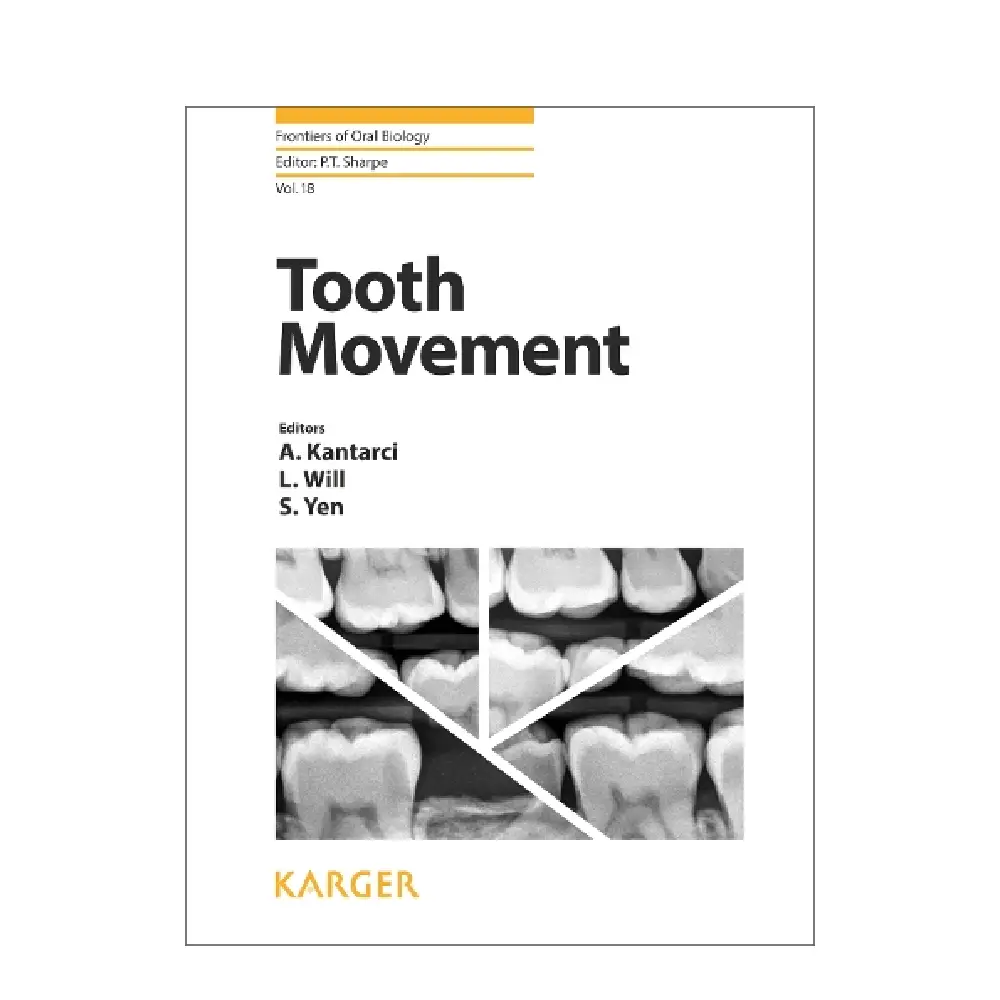


Tooth Movement (Frontiers of Oral Biology, Vol. 18) — An Overview
Tooth Movement is Volume 18 in the Frontiers of Oral Biology series, published by S. Karger AG in 2016. Edited by Alpdogan Kantarci, Leslie Will, and Stephen Yen, this specialized textbook presents a modern synthesis of scientific research on the biology, mechanics, and clinical modulation of orthodontic tooth movement — a central process in orthodontics where applied forces cause teeth to shift through bone. It integrates cellular, molecular, tissue, and clinical perspectives to help researchers and clinicians better understand both conventional and accelerated tooth movement mechanisms.
The book is designed for orthodontists, oral biologists, dental researchers, and advanced students interested in the biological underpinnings of how teeth move in response to mechanical forces, and how this process can be optimized for better clinical outcomes.
1. Broad Aims and Scope
Unlike traditional orthodontic texts that focus on appliances and biomechanics alone, this volume emphasizes biological mechanisms that drive tooth movement. It seeks to:
-
Clarify the tissue-level responses to applied orthodontic forces
-
Connect mechanical stimuli to cellular signaling pathways
-
Explore methods for accelerating or modulating movement safely
-
Highlight genetic, inflammatory, and molecular factors that influence outcomes
By situating orthodontic force application within a biological framework, the book advances a deeper understanding of how bone and periodontal tissues behave and adapt during treatment.
2. Biological Foundations of Tooth Movement
A foundational theme throughout the book is that orthodontic tooth movement is not simply mechanical displacement but a biologically mediated process involving coordinated tissue remodeling. When force is applied to a tooth:
-
Compression zones develop in the periodontal ligament (PDL) where bone resorption is initiated
-
Tension zones develop on the opposite side where bone formation occurs
-
These responses create space for the tooth to move while maintaining alveolar integrity
The volume explains that this process involves an aseptic inflammatory response, recruitment of specialized cells (like osteoclasts and osteoblasts), and modulation by cytokines, chemokines, and growth factors.
One influential model discussed in chapters (and supported by animal and cellular research) is the “biphasic theory of tooth movement”, whereby tooth movement involves a catabolic phase of bone resorption followed by an anabolic phase of bone formation. This biphasic choreography ensures that the tooth moves into newly remodeled bone with structural integrity preserved.
3. Cellular and Molecular Mechanisms
The text delves into how forces are transduced into biological signals at the cellular level:
-
Osteoclastogenesis (bone-resorbing cell formation) is triggered by signals released in compressed PDL regions.
-
Osteoblast activation follows in tension areas to rebuild bone.
-
Inflammatory mediators like cytokines (e.g., IL-1, TNF-α) and chemokines regulate the recruitment and activity of these cells.
-
Genetic factors and differences in bone turnover rates can influence how quickly and predictably teeth move.
This detailed molecular insight helps explain why two patients may respond differently to the same orthodontic force — individual biological variance matters as much as mechanics.
4. Mechanics Meets Biology
While biomechanics defines how forces are applied (brackets, wires, springs, etc.), the biological response determines how effectively teeth will shift. The book links mechanical principles with tissue responses:
-
Force magnitude and duration: Light and continuous forces stimulate remodeling more predictably than heavy intermittent forces, which can cause tissue necrosis or delay movement.
-
PDL strain: Mechanically induced strain creates regions of compression and tension that initiate cellular responses.
-
Remodeling pathways: Mechanical loading alters expression of signaling molecules that direct bone resorption and deposition.
By merging mechanobiology with cellular biology, the volume frames orthodontic tooth movement as a complex interplay between physics and physiology.
5. Clinical Modulation and Acceleration
A major clinical interest is how to optimize treatment time without compromising health. The book explores methods under study to accelerate tooth movement, including:
-
Micro-osteoperforations (MOPs) and surgical adjuncts: These techniques are intended to provoke a regional acceleratory phenomenon — a transient upregulation of inflammatory and remodeling activity — to speed movement.
-
Pharmacologic modulation: Investigating how altering cytokine pathways or cellular signaling might influence the rate of tooth movement.
-
Genetic and tissue engineering approaches: Early research on how genetic determinants affect response could eventually lead to personalized treatment protocols.
While many acceleration strategies remain under clinical research rather than standard practice, the book highlights principles that could shape future orthodontic care.
6. Conclusion: Integrating Biology and Practice
Tooth Movement (Frontiers of Oral Biology, Vol. 18) offers a state-of-the-art synthesis of research on the biological basis of orthodontic tooth movement. It expands traditional biomechanical teaching by embedding it within a cellular and molecular framework, helping practitioners think beyond braces and wires to the underlying tissue responses that ultimately determine treatment efficiency and stability.
By integrating science and clinical relevance, the volume provides a resource for both researchers and clinicians aiming to enhance orthodontic outcomes through biologically informed strategies.

Reviews
There are no reviews yet