
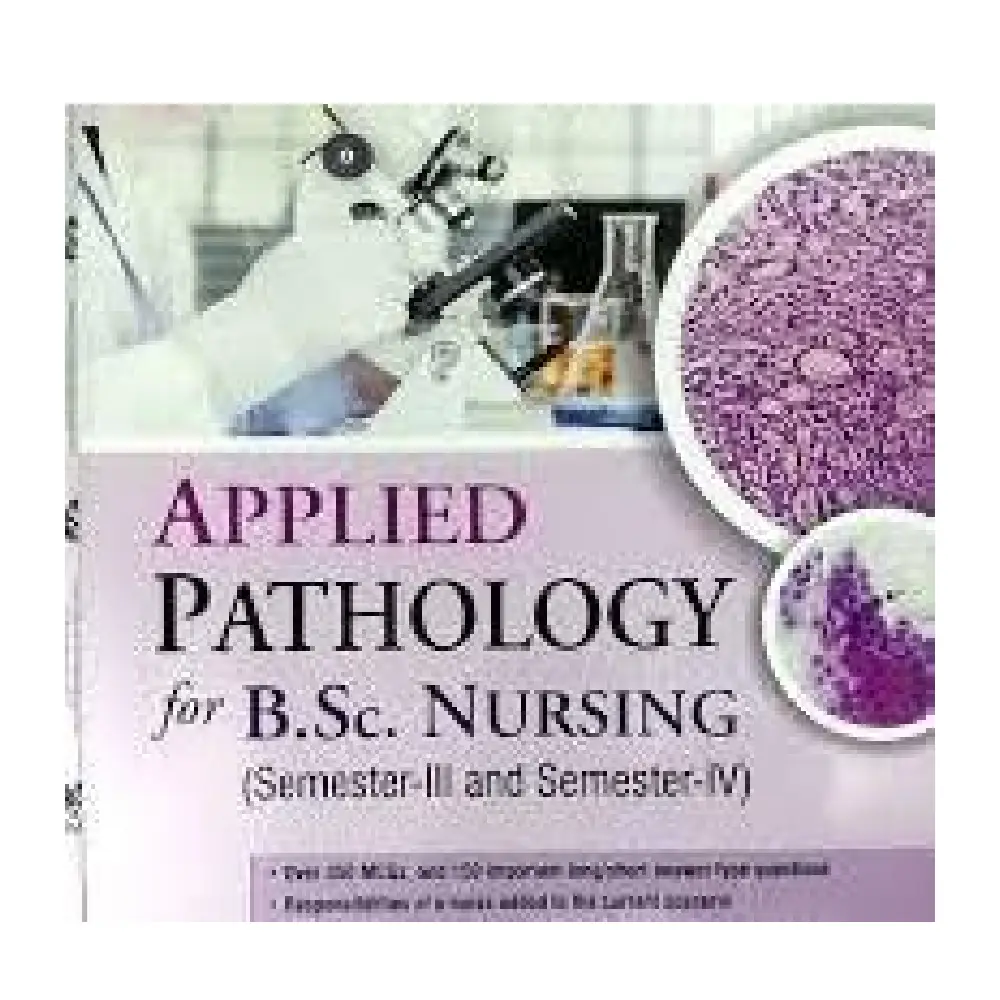
Applied Pathology for B.Sc. Nursing (2nd Edition) is a comprehensive textbook designed specifically to meet the curriculum requirements of undergraduate nursing students. This edition presents pathology in a simplified, clinically oriented manner, enabling nursing learners to understand disease processes and apply this knowledge effectively in patient care settings.
The book begins with an introduction to general pathology, covering fundamental concepts such as cell injury, inflammation, healing, infection, immunity, and neoplasia. These core principles provide a foundation for understanding how diseases develop and progress. The text explains mechanisms of disease in clear, accessible language, avoiding excessive medical jargon while maintaining scientific accuracy. This approach is particularly helpful for B.Sc. Nursing students who require a strong conceptual base without the depth expected in medical postgraduate texts.
One of the major strengths of this second edition is its system-wise organization. After discussing general pathology, the book moves into systemic pathology, where diseases are explained according to body systems. These typically include cardiovascular, respiratory, gastrointestinal, hepatobiliary, renal, endocrine, nervous, musculoskeletal, hematological, and reproductive systems. Each chapter outlines the etiology, pathogenesis, morphological changes, clinical manifestations, diagnostic investigations, complications, and basic management principles of common diseases.
The clinical correlation throughout the book is especially valuable for nursing students. Since nurses play a vital role in patient monitoring, medication administration, health education, and supportive care, understanding the underlying pathology enhances their clinical judgment. For example, when studying conditions like anemia, diabetes mellitus, hypertension, tuberculosis, or cancer, the book links pathological changes with signs and symptoms that nurses observe in real-world hospital settings. This integrated approach strengthens both theoretical knowledge and practical skills.
Illustrations, flowcharts, tables, and diagrams are widely used to enhance comprehension. Visual aids simplify complex processes such as inflammatory pathways, immune responses, tumor progression, and organ-specific disease mechanisms. The second edition has been revised to include updated classifications, recent terminology, and current diagnostic approaches, ensuring that students are learning in alignment with modern medical standards.
Another important feature is the inclusion of laboratory investigations and their interpretation. Nursing students often assist in sample collection and patient preparation for diagnostic procedures. By understanding laboratory values and pathological findings, they can better participate in patient care and interdisciplinary communication. The book explains commonly used tests such as complete blood count (CBC), liver function tests (LFT), renal function tests (RFT), blood glucose levels, and imaging correlations in a simplified format.
In addition to disease mechanisms, the textbook emphasizes patient-centered care. Many chapters include nursing implications, highlighting the role of nurses in prevention, early detection, complication management, and patient education. This makes the book not just a pathology reference, but also a practical guide aligned with nursing responsibilities.
The language of the book is clear and structured, with key points summarized at the end of each chapter for quick revision. Some editions also provide review questions, multiple-choice questions (MCQs), and short-answer questions to assist students in exam preparation. This is particularly useful for university examinations and competitive nursing tests.
The second edition reflects updates in areas such as oncology, infectious diseases, metabolic disorders, and immune-related conditions. With emerging health challenges and evolving treatment modalities, having an updated edition ensures relevance in contemporary healthcare practice.
Overall, Applied Pathology for B.Sc. Nursing (2nd Edition) serves as an essential academic resource for undergraduate nursing students. It bridges the gap between basic medical science and clinical nursing practice. By focusing on clarity, clinical relevance, and exam orientation, the book helps nursing students build a solid understanding of disease processes while preparing them for safe, competent, and evidence-based patient care.

Reviews
There are no reviews yet